
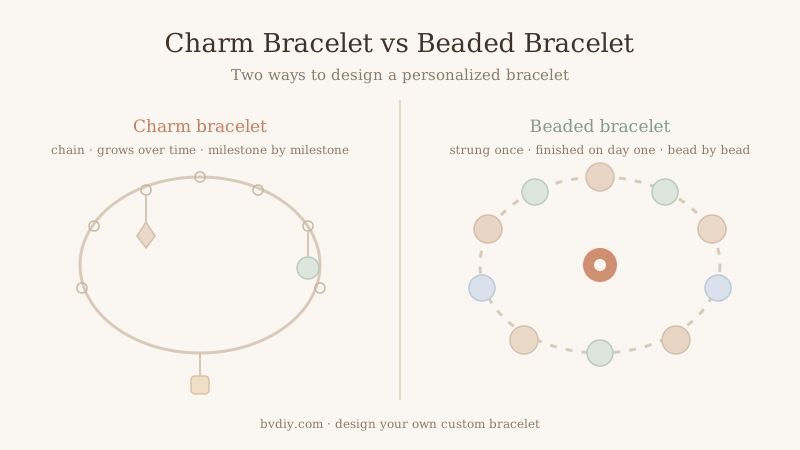
Charm bracelets and beaded bracelets share a wrist but not a method. One is designed in a single sitting, bead by bead, and finished before it ships. The other starts as a base and grows by addition, one charm at a time, for years. Here is how each style is built, how they wear day to day, and how to tell which one you are actually trying to design.
What a beaded bracelet is
A beaded bracelet is a strand of beads threaded onto elastic cord, beading wire or nylon thread. Every bead occupies a position you chose, which means the design is complete the moment the strand is tied or clasped. Nothing needs to be added later for it to feel finished.
That makes beaded designs the natural home for symbolic work. A birthstone in the middle, two smaller accents on either side, a name in letter beads, a hidden message in Morse code — all of it can be laid out and checked before a single bead is threaded. You can browse and preview every option in the bead library while you plan.
What a charm bracelet is
A charm bracelet begins with a base: a link chain, a bangle, or a snake chain with small soldered loops. The base is the bracelet. Meaning arrives by addition — a charm for a birthday, a trip, a pet, a graduation, a first home — and the bracelet accumulates character over months and years.
That is both the appeal and the trade-off. A charm bracelet is rarely finished, which is precisely what makes it a long-term project. It is also a heavier, noisier object: charms swing independently, catch on knitwear, and hang below the wrist rather than sitting flat against it.
The differences that matter on the wrist
- Design timing. Beaded is designed in one session. Charm is designed across years, one addition at a time.
- Weight and movement. A beaded strand moves as one piece and sits quietly. Charms move separately and carry their weight at the lowest point of the chain.
- Sizing. Beaded length is set at the stringing stage and fixed from then on — our wrist measuring guide covers getting it right. Charm bases are adjusted with extra links and tend to grow heavier rather than longer.
- Sound. Charms against a chain are audible. Beads on cord are nearly silent, which is worth considering if the bracelet will be worn at a desk or in a quiet room.
- How personalisation reads. Beaded personalisation is visual and immediate: colour, stone, letters, order. Charm personalisation is object-based: one small cast or engraved piece per milestone.
Which one wears better day to day
For daily wear, a beaded bracelet is usually the easier companion. It stays flat, does not tangle in sleeves, sits comfortably next to a watch, and needs nothing added to feel complete. Elastic versions go on without help; wire versions wear more like fine jewellery and hold their shape for years.
Charm bracelets work better as occasion pieces or as a slow collection you add to deliberately. They take more knocks, need cleaning between the charms, and ask to be worn on purpose rather than forgotten.
Which style fits the gift you are planning
One question usually settles it: does the meaning already exist, or is it still arriving?
- Meaning already exists — a milestone you are marking now, someone's colours, a name, a date, a birthstone, a place that matters. Go beaded. Everything the bracelet should say can be said on day one.
- Meaning is still arriving — a young child, a new graduate, someone starting a career or a family. A charm base gives future moments somewhere to land.
Beaded bracelets also travel better as gifts, because the fit and the finished look are settled before they arrive. A charm base needs a length decision, and when the gift is a surprise, someone else has to make that call for the wearer.
If you want both: a beaded base with one charm
The two styles are not mutually exclusive. A common approach is to design a beaded strand and place a single charm at the centre as the focal point — a small initial, a heart, a tiny shape that echoes the story. You keep the finished, wearable-now quality of beads and gain the weight and focal point a charm brings.
Two practical notes. Keep the charm light, and string on wire rather than elastic if it weighs more than a few grams: a charm pulls from a single point, and wire carries that pull without stretching. Placement matters as well — centre for an even look, or off-centre by a bead or two when the strand has an odd bead count.
How to start designing
Once you know which direction you are going, the remaining decisions get concrete and quick:
- Choose the base. Elastic for easy, clasp-free fit; wire for hand-tied structure and a closure — our stretch versus clasp guide covers the trade-off.
- Find the meaning first, then the palette. Colour is far easier to choose once you know which bead is carrying the story.
- Settle on bead size. Size drives bead count, weight and how the bracelet sits; our bead size guide compares 6mm, 8mm and 10mm.
- Lay it out bead by bead. Swap an accent, move the centrepiece, look again. That is the entire point of designing your own.
When you are ready, you can design your bracelet bead by bead, check each bead's size in the bead library, and preview the finished strand before ordering.
Ready to build it? Choose your beads, set the order and see your bracelet come together bead by bead.