
A Chinese zodiac bracelet can start with an animal and end with colors you'd wear every day. Find the right year first, then choose the contrast, bead size and arrangement. The animal is a starting point; your taste decides the finished design.
To choose Chinese zodiac bracelet colors, confirm your birth-year animal, then select a main bead color and one or two accents. January and February birthdays need the exact date because Chinese New Year moves each year. BVDIY's 12 animal palettes are editable design suggestions, not prescribed lucky stones. Change any material or arrangement before ordering.
How do I find my Chinese zodiac animal?
The Chinese zodiac follows a repeating twelve-year animal cycle. For this guide and the studio's finder, the animal changes at Chinese New Year, rather than January 1. The Hong Kong Observatory publishes both the animal cycle and Gregorian-to-lunar calendar tables used to check that boundary.
For example, Chinese New Year in 1990 fell on January 27. A birthday on January 26, 1990 belongs to the Snake year under this convention; January 27 belongs to the Horse year. In 2027, the Goat year starts on February 6, so February 5 still belongs to the Horse year.
Enter your year in the finder. If your birthday falls in January or February, tick the date-check box and enter the month and day. A year-only answer is provisional. Someone born later in the year doesn't need that extra check.
Aries, Taurus and the other Western signs use a different system. If you were looking for a month-and-day sign rather than a year animal, open the Western zodiac designs.
Which bead colors can I choose for each animal?
Choose from the palettes below by appearance, not obligation. These are BVDIY studio compositions using materials currently available in the bead library. The colors aren't a traditional animal-to-gemstone prescription, and choosing another palette doesn't make a bracelet incorrect.
| Animal | Palette | Materials in the starting design |
|---|---|---|
| Rat | Ink & Water: pale blue and black-lined clear beads | Aquamarine, Tourmalinated Quartz, Clear Quartz |
| Ox | Earthbound: golden brown with a deep red center | Yellow Tiger's Eye, Garnet, Clear Quartz |
| Tiger | Amber Stripe: warm brown with dark patterned accents | Yellow Tiger's Eye, Tourmalinated Quartz, Garnet |
| Rabbit | Soft Bloom: pink, pale blue and clear | Rose Quartz, Aquamarine, Clear Quartz |
| Dragon | Plum & Gold: purple, wine red and gold-toned inclusions | Brazilian Amethyst, Garnet, Golden Rutilated Quartz |
| Snake | Silver Line: black inclusions, clear and golden accents | Tourmalinated Quartz, Clear Quartz, Golden Rutilated Quartz |
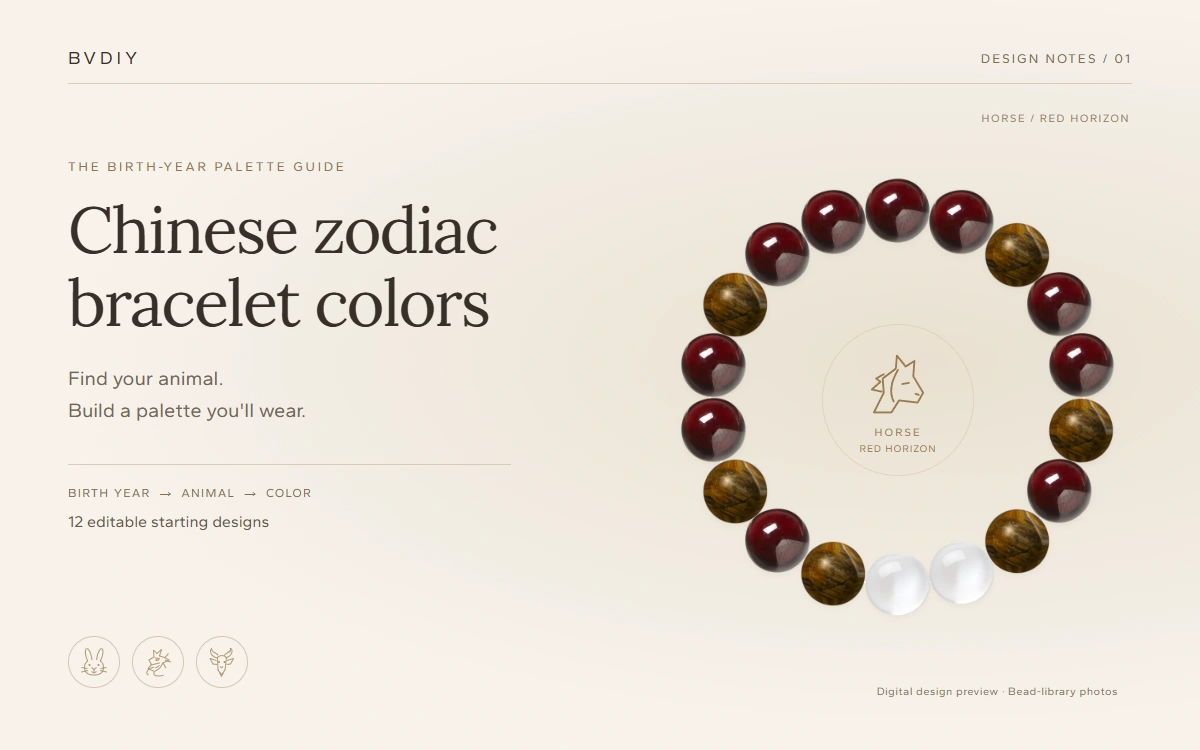
| Horse | Red Horizon: wine red, golden brown and clear | Garnet, Yellow Tiger's Eye, Clear Quartz |
| Goat | Soft Clay: peach, pink and clear | Cherry Blossom Rhodonite, Rose Quartz, Clear Quartz |
| Monkey | Golden Play: clear with brown and gold-toned accents | Clear Quartz, Yellow Tiger's Eye, Golden Rutilated Quartz |
| Rooster | First Light: a clear base with red and golden markers | Clear Quartz, Garnet, Golden Rutilated Quartz |
| Dog | Steady Trail: warm brown with clear and dark-lined bands | Yellow Tiger's Eye, Clear Quartz, Tourmalinated Quartz |
| Pig | Rose Garden: pink with purple and clear accents | Rose Quartz, Brazilian Amethyst, Clear Quartz |
The animal drawings identify the palettes on screen. They aren't charms included in the bracelet. Material names follow the bead catalog; a trade name or photograph alone doesn't establish composition, origin or treatment. Read the individual material label when choosing.
How do I turn a palette into a bracelet I'll wear?
Start with the color you want to see most, then use the remaining beads to control contrast. A pale Rabbit arrangement and a dark Dragon arrangement can use the same wrist size while looking very different.
- For a lighter design: increase the pale or clear beads, keeping a small group of colored accents together.
- For a darker design: keep Garnet or Amethyst as the main color and use clear beads sparingly.
- For a visible pattern: repeat the same accent at regular intervals. A single accent bead produces a different effect from six scattered accents.
Change the pattern after loading a starting design. You can replace a bead, move it around the strand or choose a different wrist and bead size. The studio recalculates the number of positions, so a larger bead size may need a new arrangement rather than a direct copy of an 18-bead recipe.
What does a complete Horse bracelet design cost?
The Red Horizon Horse starting design costs $65.89 USD before shipping at the prices checked on November 14, 2026. It is a single-loop stretch bracelet for a 16 cm wrist, using 18 beads at 10 mm. The composition has ten Garnet, six Yellow Tiger's Eye and two Clear Quartz beads.
| Component | Quantity | 10 mm unit price | Subtotal |
|---|---|---|---|
| Garnet | 10 | $3.68 | $36.80 |
| Yellow Tiger's Eye | 6 | $2.07 | $12.42 |
| Clear Quartz | 2 | $1.84 | $3.68 |
| Stretch bracelet base | 1 | $12.99 | $12.99 |
| Total before shipping | 18 beads | $65.89 |
The 16 cm figure is your wrist measurement, not the bracelet's finished length. The studio adds room for fit. Measure first using the wrist measurement guide; the current supported range is 14 to 20 cm.
Open the exact Horse bead sequence to inspect the arrangement or change it. Prices and stock can change, so the live studio total takes precedence over this worked example.
What should I check before ordering?
Check the saved bead sequence, wrist measurement, bead size and live total before paying. Each inspiration card is a digital arrangement made from bead-library photos, not a photograph of a finished bracelet. Natural color, texture and markings will vary.
Designing and previewing are free; ordering the bracelet is paid. BVDIY makes the design you submit rather than selling these animal palettes as ready-made pieces. If a material is unavailable, the starting design is disabled instead of silently replacing a bead. You can choose other available materials in the studio.
Sources and checks: Hong Kong Observatory, The 12-Year Animal Cycle and Gregorian-Lunar Calendar Conversion Tables, linked above. The New Year dates were checked against the Observatory's 1990 calendar table and 2027 calendar table. Palette materials, bead counts and prices were checked against the live studio on November 14, 2026. The calendar facts come from those official tables; the color arrangements are this studio's design choices.