
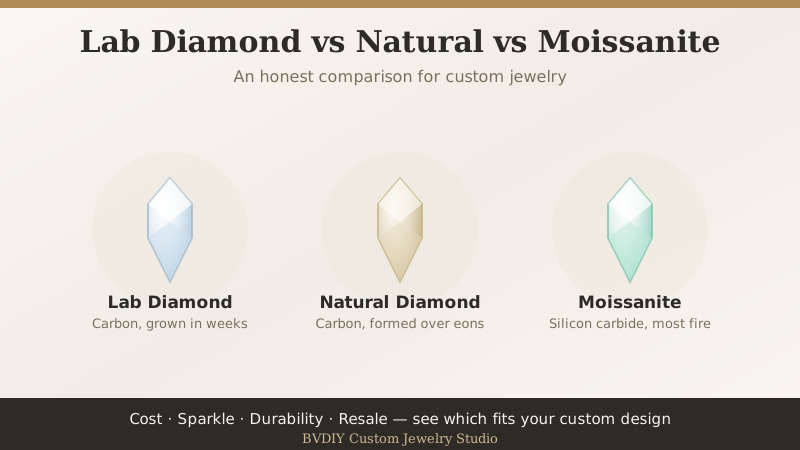
The first question every custom jewelry buyer asks is the same: should I get a lab diamond, a natural diamond, or moissanite? The short answer is that there is no single right stone — there is only the right stone for your budget, your values, and what you want the piece to mean. This guide compares all three honestly, without the marketing, so you can decide with your eyes open.
We custom-make rings, bracelets, necklaces, and earrings in all three materials, and we have worked with hundreds of first-time buyers. The choice comes down to four things: what the stone actually is, how much it costs, how it looks, and what happens to it years from now.
Choose a natural diamond if resale value or heirloom tradition matters most and budget is flexible. Choose a lab diamond if you want a real diamond — identical chemically and optically — at 50–70% less than natural. Choose moissanite if you want the most sparkle per dollar and do not need the stone to be a diamond; it is a different gemstone (silicon carbide) that costs a small fraction of a lab diamond. All three are durable enough for everyday wear.
What each stone actually is
Before comparing prices, it helps to know what you are looking at. A natural diamond is crystallized carbon that formed deep underground roughly one to three billion years ago and reached the surface through volcanic activity. A lab grown diamond is the exact same material — pure carbon in the same crystal structure — grown in a controlled chamber over a few weeks using high pressure and heat or chemical vapor deposition. If you put a lab diamond and a natural diamond side by side, no one can reliably tell them apart without laboratory instruments.
Moissanite is different. It is silicon carbide, a naturally rare mineral that was first discovered in a meteor crater and is now produced synthetically. It is not a diamond and was never meant to imitate one exactly — it has its own optical personality. It sparkles more than a diamond in colored flashes because it has a higher refractive index and double refraction. Many buyers choose it precisely for that extra fire; others find it too colorful next to a diamond.
Lab diamond vs natural diamond: the real differences
Physically, there is essentially no difference. Both are carbon, both rate 10 on the Mohs hardness scale, both sparkle the same way. The differences are origin, price, and resale.
Price. A lab diamond typically costs 50–70% less than a natural diamond of the same carat weight, cut, color, and clarity. The reason is supply chain: a natural diamond passes through mines, sorting houses, auctions, and multiple intermediaries; a lab diamond moves from growth chamber to cutter to setting with far fewer hands in between. You are not paying for lower quality — you are paying for a shorter journey.
Resale. This is the honest trade-off. Natural diamonds have an established secondary market — jewelers buy them back, and certified stones can be sold. Lab diamonds have almost no resale market today; most jewelers will not buy them back. If you think of jewelry as a long-term asset, that matters. If you think of it as something to wear and enjoy for decades, it probably does not.
Values and environment. Lab diamonds avoid the ethical and environmental questions of mining, which is a decisive factor for many buyers. There is no wrong answer here — it depends on what matters to you.
Lab diamond vs moissanite: what actually differs
This is the comparison most people get wrong, so let us be specific. A lab diamond is a diamond; moissanite is not. Here is how they differ where it counts:
Sparkle. Both are brilliant, but they sparkle differently. A diamond's brilliance is white and crisp with modest fire. Moissanite produces more fire — rainbow flashes — and can show double refraction, where facets appear slightly doubled up close. Some people prefer the calmer elegance of a diamond; others love how moissanite catches light.
Hardness. Diamond is 10 on the Mohs scale; moissanite is 9.25. In daily wear, both are effectively scratch-proof. Moissanite is harder than sapphire and will not dull, cloud, or scratch under normal conditions.
Price. Moissanite typically costs a small fraction of a lab diamond. For a buyer whose priority is a brilliant, durable stone at the lowest possible cost, moissanite is the clear value winner.
Which stone should you choose?
Here is the decision path we walk every custom jewelry client through:
If budget is your first concern and you want a real diamond: choose a lab diamond. You get everything a diamond is — hardness, brilliance, authenticity — without the natural-diamond markup. This is the most popular choice for custom engagement rings at BVDIY.
If you want maximum sparkle for the least money and do not need it to be a diamond: choose moissanite. It is a beautiful gemstone in its own right, extremely durable, and it frees up your budget for the metal and design work that make a custom piece special.
If resale value, tradition, or heirloom meaning is the point: choose a natural diamond. You are paying for rarity and an established market, and the piece becomes part of a longer story.
If you cannot decide: let the design decide. When you customize a piece with us, we show you the same ring, bracelet, or pendant set with each stone so you can see the difference on your own hand — not in a marketing photo. Start a design in the BVDIY custom design studio and tell us your budget; we will recommend the stone that fits both.