
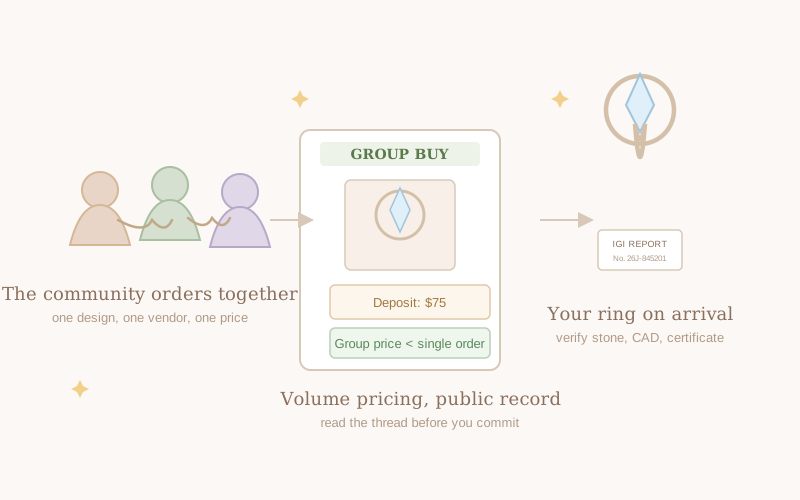
A lab diamond group buy is one of the most efficient ways to buy a custom ring: a community agrees on a design, a vendor produces it for everyone at once, and the volume brings the price down. The arrangement lives in public threads, which makes it more transparent than most jewelry shopping. It also has real mechanics and real risks. This guide explains how a group buy actually works, what you can expect to save, and the checks that still matter before you send a deposit.
A group buy is a volume order: a coordinator negotiates a design and price with a vendor, members pay a deposit, and the vendor makes the same ring for the whole group at a per-piece price below an individual custom order. The savings come from volume, and the transparency comes from the public thread. Before joining, read the coordinator's past group buys, confirm the vendor's history, check the itemized price breakdown, and verify your stone against its certificate when it arrives. The group discount does not replace the usual verification steps.
1. How a group buy actually works
The structure is simple. A coordinator — usually an experienced member of a community like r/LabGroupSales — posts a proposed design with a vendor's price. Members who want the piece commit, typically with a deposit. Once enough people join, the vendor produces the design for the whole group, and members pay the balance when the pieces are ready to ship. The coordinator documents the whole process in the thread: the price breakdown, the timeline, and later the finished rings.
That public documentation is the real value of the format. An individual custom order happens privately between you and a vendor; a group buy happens in the open, and every past group buy stays visible. You can see what a vendor quoted before, how long production actually took, and whether buyers were satisfied after delivery. No other jewelry-buying format offers that level of audit history.
2. Where the savings come from
Vendors price group orders lower per piece because one design, one production run, and one shipping batch cost them less than many individual orders. The savings show up in the price breakdown, which serious coordinators post in full: stone cost, setting cost, shipping, and any fees. You can compare that breakdown against an individual quote for the same specification and see exactly what the group discount is worth.
Two honest notes. First, the group price is only a good price if you actually want the design — a bargain on a ring you would not have chosen is not a saving. Second, the stone itself is still priced by carat, color, clarity, and cut, so a group buy with a smaller or lower-grade stone will cost less than one with a larger or higher-grade stone for reasons that have nothing to do with the discount.
3. The checks that still apply
Read the coordinator's history. Experienced coordinators have past threads with finished rings, price breakdowns, and follow-up posts. Read those before joining anything. A coordinator's first group buy deserves extra caution, not extra trust.
Verify the vendor, not just the group. A group buy is a single vendor relationship wearing a community costume. Check the vendor's name in r/labdiamond and r/LabGroupSales the same way you would for an individual order — documented history, photos of real stones, and honest reports of problems as well as successes.
Confirm the price breakdown in writing. You should be able to see the stone cost, the setting cost, and the shipping cost separately, with the certificate number for the stone. If the breakdown is vague, ask for specifics before paying a deposit.
Pay with buyer protection. Deposits are normal, but they should go through a method that gives you recourse. Wire transfers and crypto do not. A legitimate group buy can accept cards or PayPal; a scam usually cannot, which is why the payment method is one of the fastest filters.
Verify your stone on arrival. When your ring arrives, enter the certificate number on the IGI or GIA website, confirm the laser inscription on the girdle matches the report, and compare the stone's dimensions against the certificate. The group buy saved you money; it did not remove the need for this step.
4. When a group buy makes sense — and when it does not
A group buy makes sense when the design is something you genuinely want, the vendor and coordinator have real history, and the itemized price is meaningfully below an individual quote for the same specification. First-time buyers often find it a gentler entry than a fully custom one-off, because the design has already been made and reviewed by other members of the group.
It makes less sense when you want something genuinely unique, when the timeline is urgent, or when the group discount would push you into a design you were not planning to buy. A custom piece you love at a normal price beats a discounted piece you settled for. If you want a fully custom lab-grown diamond ring built around your own specification rather than a group design, BVDIY's custom ring studio follows the same discipline — your stone, your setting, your design, made to order — and the bracelet designer works the same way for beaded pieces.
5. The bottom line
Group buys work because they trade a little coordination effort for a lower price and a public record. The discount is real, the transparency is real, and so are the risks that come with any single-vendor jewelry order. Treat the group buy as a way to save money within a process you still verify yourself: read the history, confirm the breakdown, pay with protection, and check the certificate when the ring arrives. Do that, and a group buy is one of the best deals in custom jewelry. Skip the checks, and the discount is not worth it.