
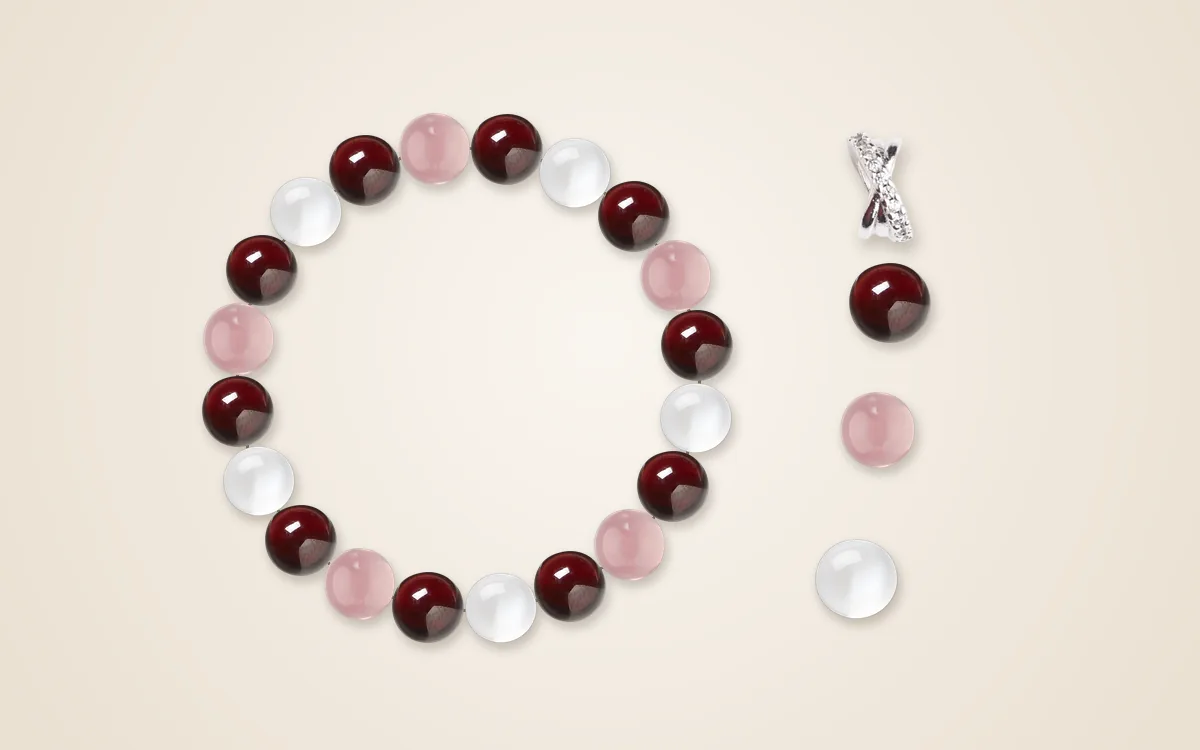
A good anniversary bracelet counts something real, such as your years together or the month you married. Here's what the traditional anniversary lists do and don't say about stones, how to put the years into beads, and two priced designs you can copy into the bracelet studio.
Build the design from your own numbers rather than an anniversary chart: one accent bead per year up to about 15, or one per decade after that, spaced evenly on a neutral base. Add your two birthstones at the center if you want a second layer. A five-year bracelet on an 18 cm wrist at 10 mm has 20 positions and costs $65.89.
What do the traditional anniversary lists say about stones?
The traditional anniversary lists say very little that helps on a bracelet. They vary by country and by publisher, and most of what they name is a material: the traditional US list gives paper for the first year and wood for the fifth, while silver for the 25th and gold for the 50th are close to universal. Modern versions swap many of the years, so a stone you find on one chart may not appear on the next.
A few later years do name gems, such as pearl for the 30th and ruby for the 40th. The BVDIY bracelet studio doesn't carry either: it builds with natural gemstone beads only, from a library of 35, and there are no pearls, wood beads or metal spacers in it. Garnet is a red stone, but it isn't ruby, and telling someone it stands in for ruby is a stretch you'd have to explain.
The honest way to use the lists is as a color prompt and nothing more. For a wood year, a brown stone such as Bronzite or Smoky Quartz can echo the idea, as long as the card says what the stone actually is. For most other years, skip the chart. Your wedding date and your birth months give you better material.
How do you show the number of years in beads?
Use one accent bead per year, spaced evenly around a neutral base, up to the point where the accents take over the strand. The bracelet studio gives each wrist a fixed number of positions, so you can work out the spacing ahead of time. These are the patterns that come out even on a stretch bracelet:
| Years | Wrist and bead size | Positions | Even pattern |
|---|---|---|---|
| 3 | 18 cm at 8 mm | 24 | 1 accent, 7 base, three times |
| 5 | 18 cm at 10 mm | 20 | 1 accent, 3 base, five times |
| 7 | 19 cm at 10 mm | 21 | 1 accent, 2 base, seven times |
| 10 | 20 cm at 10 mm | 22 | 1 accent, 1 base, ten times, plus 2 extra base at the back |
| 15 | 16 cm at 6 mm | 29 | 1 accent, 1 base, fourteen times, plus 1 last accent at the back |
Past about 15 years, count decades. A 40th is four accent beads, a 50th is five, and you can group them at the center front rather than spacing them out. A 30-year bracelet with three stones side by side looks deliberate; thirty accent beads on a 6 mm strand just look like a strand of that stone.
What does a five-year anniversary bracelet look like?
A five-year bracelet can use five accent beads spread around a brown strand, which also fits the wood-year idea without pretending to be wood. Here's the build for an 18 cm wrist at 10 mm, where the studio gives 20 positions:
- Place one Garnet, then three Bronzite, and repeat five times.
- That's 5 Garnet at $3.68 and 15 Bronzite at $2.30.
- With the $12.99 stretch base, the total is $65.89.
Garnet is traditionally associated with devotion and lasting friendship, and it's a dark red that stays muted against brown. Bronzite is a metallic-looking brown stone, so this reads well on someone who doesn't wear much jewelry. At 10 mm the strand is bold, so if the wrist is under 16 cm, drop to 8 mm and rework the spacing.
How do you put both of your birthstones on one bracelet?
Set the two birthstones side by side at the center front, then add a third stone for the month you married. This gives you a small cluster that means something to the two of you and looks like a plain accent to everyone else. Exact birthstones are only available for some months: Garnet for January, Amethyst for February, and Aquamarine or Bloodstone for March. For other months, pick by color and be upfront that it's a color match. The birthstone ideas by month go through the options.
Worked example: one of you was born in February, the other in March, and you married in January. For a 17 cm wrist at 6 mm, the studio gives 31 positions:
- Center front: Garnet, Amethyst, Aquamarine, Garnet (a wedding-month stone on each side of the pair).
- The other 27 positions: Peach Aventurine at $1.80, traditionally linked with warmth and gentle love.
The total comes to $73.59 with the $12.99 base. At 6 mm a cluster of four stays small, which is the point: it's for the two of you, not for the room.
Which stones suit a bracelet they'll wear every day?
Pick stones that can handle daily wear, because an anniversary bracelet that stays in a box hasn't done its job. Quartz-family stones are the safest base: Smoky Quartz, Rose Quartz, Peach Aventurine, Tiger's Eye and the agates all rate about 6.5 to 7 on the Mohs scale. Garnet and Aquamarine are at least as hard. Bronzite is softer, around 5 to 6, which is fine for ordinary wear but will show knocks sooner.
Keep softer stones to accents. Rhodochrosite and Malachite are about 3.5 to 4, and Selenite is about 2 and has to stay dry. If your partner never takes jewelry off, leave those three out, along with Pyrite and Hematite, which are best kept dry. A stretch bracelet has no clasp, so it rolls on and off in a second, but someone has to remember to do it.
Check what the rest of their jewelry looks like, too. Studio bracelets have no metal spacers to match, so warm stones go next to gold and cool stones go next to silver, and that's about the whole rule. For a set you both wear, see the matching couple bracelet guide; for a gift aimed specifically at a spouse, try the wife or husband pages.
When should you order for an anniversary date?
Count back about three weeks from the anniversary. Orders are processed in 1 to 3 business days, then standard shipping takes 5 to 10 business days, so the slowest case is 13 business days from the day you order. Shipping is $5.99, free on orders over $99, and goes to the United States, Canada and most other countries.
Getting the size right matters more than usual, because you can't try it on them in secret. Custom designs are final sale. Enter the wrist measurement itself in whole centimeters, from 14 to 20, round up if you land between two sizes, and let the studio add its own 1.2 cm of ease. Wrists outside that range need an email to [email protected] before ordering. The guide to measuring a wrist includes a way to do it when the gift is a surprise.
Sources: Birthstones by month: GIA birthstones by month. Hardness of garnet, aquamarine and bronzite: Mindat mineral database. Stone meanings here are traditional folklore, not health or financial advice.