
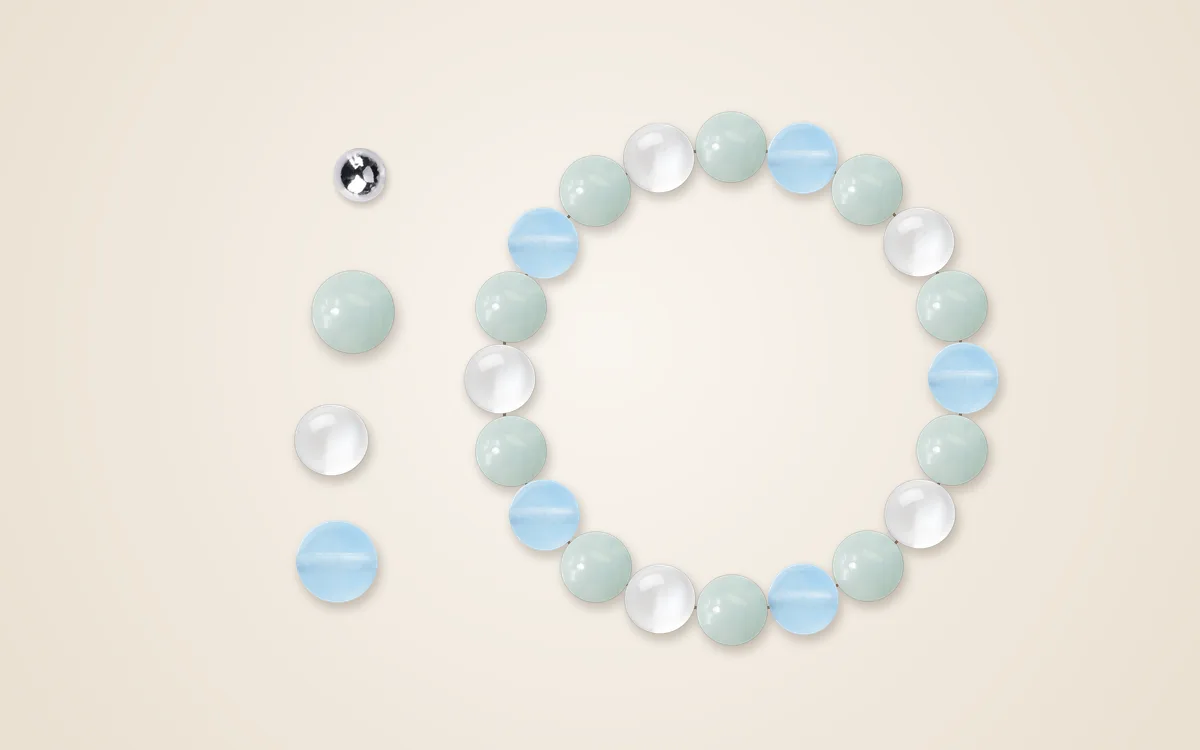
Aquamarine is one of the palest stones in the BVDIY bead library, and pale stones are easy to get wrong. This guide covers what aquamarine beads look like on a wrist, which neighboring stones keep them looking blue, and what different layouts cost.
Aquamarine beads are a soft, slightly cloudy sea blue. Pair them with clear or pale stones, or shade them into deeper blues; next to black or dark red they turn grey. Bigger beads mean fewer of them, so a full aquamarine strand for an 18 cm wrist costs $91.19 at 10 mm (20 beads at $3.91) and $121.79 at 6 mm (32 beads at $3.40).
What do aquamarine beads look like?
Aquamarine beads are pale blue to slightly greenish blue, translucent rather than glass-clear, often with faint white veils inside. Aquamarine is the blue variety of beryl, and the clean, deeper-colored crystal mostly goes into faceted gems. Beads are usually cut from the paler, more included rough, which is why an aquamarine bracelet looks like sea glass rather than a sapphire.
On the gem market, aquamarine is often heated to shift greenish crystal toward a purer blue. The studio's Aquamarine bead card lists no treatment. Expect some variation along a strand: one bead a little greener, another a little paler. That is normal for a natural stone and is easier to live with if you judge the tone of the whole strand rather than the single best bead in a photo.
Which stones keep aquamarine looking blue?
Aquamarine looks bluest next to clear, white or slightly deeper blue stones, and greyest next to black, brown or dark red. Strong contrast makes a pale color look washed out. In practice:
- Clear Quartz is the safest partner. It is transparent where aquamarine is milky, so the blue reads as the color in the strand.
- Blue Lace Agate ($2.40) has pale blue bands and sits in the same family of tones. Alternate the two for a soft, banded look.
- Iolite ($2.60) and Sodalite ($1.40) are deeper blues. Used at the ends of a strand, they make the aquamarine in the middle look lighter and brighter.
- Angelite is opaque pale blue and close in color. It's a good partner if you want a matte, chalky blue next to the translucent aquamarine.
- Black Onyx, Garnet, Hematite are the ones to avoid as direct neighbors. One or two at the back of the strand are fine; side by side with aquamarine, the pale beads look grey.
Skin is a neighbor too, and pale stones shift more with it than dark ones do. The guide to bead colors and skin tone goes further.
How do you build a sea-to-shore blue gradient?
A gradient runs from the deepest blue at the ends to aquamarine in the center, like water getting shallower toward a beach. It works best on the studio's hand chain or on a stretch bracelet at 8 mm, where each bead is big enough to read as its own shade. The build below is a hand chain for a 16 cm wrist at 8 mm, which the studio gives 23 positions:
- Start with 2 Sodalite.
- Then 2 Iolite.
- Then 3 Blue Lace Agate.
- 9 Aquamarine in the center.
- Mirror the start: 3 Blue Lace Agate, 2 Iolite, 2 Sodalite.
That is 9 Aquamarine, 6 Blue Lace Agate, 4 Iolite and 4 Sodalite. With the $14.99 hand chain base, the total is $75.99. On a 17 cm wrist the hand chain gets 25 positions; add one Aquamarine on each side of the center block and keep the rest the same.
Does bead size change what an aquamarine bracelet costs?
Yes, a lot, because smaller beads mean many more of them. A 10 mm bead costs 15% more than the listed price and the two largest sizes cost more again, but the count drops faster than the price rises. At $3.40, Aquamarine is one of the pricier beads in the library, so the gap shows. A full aquamarine stretch bracelet for an 18 cm wrist:
| Bead size | Positions | Beads | Total with $12.99 base |
|---|---|---|---|
| 6 mm | 32 | $108.80 | $121.79 |
| 8 mm | 24 | $81.60 | $94.59 |
| 10 mm | 20 | $78.20 | $91.19 |
| 12 mm | 18 | $81.00 | $93.99 |
| 14 mm | 16 | $82.72 | $95.71 |
Pale stones are the ones that suit larger beads best, since a 10 mm aquamarine shows more of its color than a 6 mm one. For the same 18 cm wrist at 10 mm, alternating 10 Aquamarine with 10 Clear Quartz gives you an even, light strand for $70.49. The 6 mm full strand is the only one of these over the $99 free shipping line. If you're unsure which size suits the wrist, the bead size comparison shows every size side by side.
Why is aquamarine linked with the sea?
Aquamarine takes its name from the Latin for seawater, and an old sailors' legend held that the stone kept people safe at sea. The studio bead card carries the same idea: aquamarine is traditionally associated with calm and clarity, like still water. In the bead library it sits under the Calm filter, next to Blue Lace Agate, Iolite, Sodalite, Selenite and Botswana Agate. These are traditional associations, not effects anyone can promise.
Aquamarine is also the modern birthstone for March. The birthstone ideas by month cover the other eleven.
How do you look after an aquamarine bracelet?
Aquamarine is harder than quartz, about 7.5 to 8 on the Mohs scale, so daily wear and handwashing don't bother the stone. The weak points are the cord and the polish. Take the bracelet off for swimming, since chlorine and salt water wear elastic, and wipe off sunscreen, which leaves a film that makes pale beads look dull. Wash with mild soap and lukewarm water, then dry the strand flat. The full routine is in the bracelet care guide.
Sources: Aquamarine as beryl, common heat treatment, name origin and March birthstone: GIA Gem Encyclopedia and GIA birthstones by month. Hardness: Mindat mineral database. Stone meanings are traditional folklore, not health advice.