
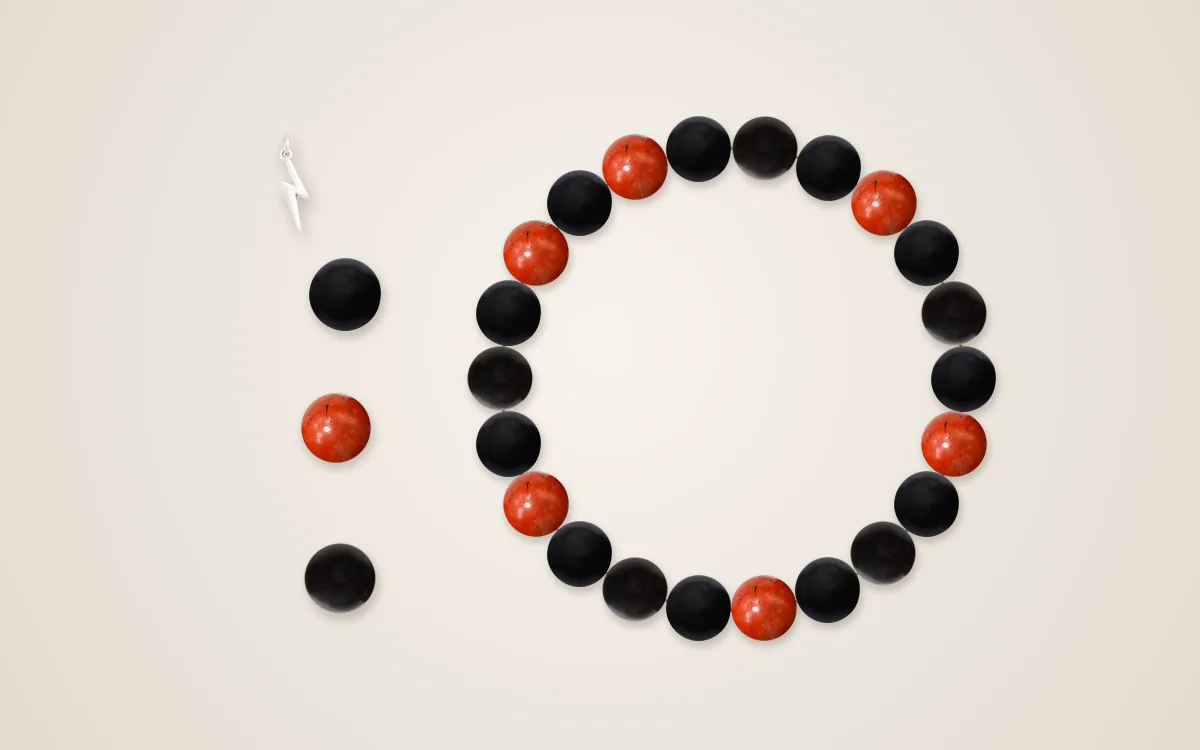
What works for a son depends on his age more than on anything else: a seven-year-old, a fifteen-year-old and a son with children of his own want different bracelets. This guide takes each stage in turn, starting with the one hard limit, which is that the studio's smallest size is a 14 cm wrist.
Measure first: the studio makes wrists from 14 to 20 cm, and many younger children measure under 14 cm, which is outside the range. For a school-age boy who fits, use hard quartz-family stones in his favorite colors at 8 mm or 6 mm. For a teenager, keep it dark and plain, or send him the studio link and let him design it. The kid's bracelet below costs $41.59.
Will the studio sizes fit my son?
The bracelet studio fits wrists from 14 to 20 cm, so a boy whose wrist measures under 14 cm is outside the range. Many younger children are under 14 cm. Measure before you design anything; if he comes in under, email [email protected] before ordering.
Don't enter 14 to make a smaller wrist fit. A 14 cm entry gives a strand of about 15.2 cm, so on a 12.5 cm wrist the bracelet would be close to 3 cm loose, enough to slide over his hand on the playground. Rounding a reading like 13.8 cm up to 14 is the normal rule; entering 14 for a 12.5 cm wrist is not.
Beaded jewelry of any kind isn't for babies, toddlers or a child who still chews things: if the cord breaks, the beads are a choking hazard. Even for older kids, the bracelet comes off at bedtime.
Which stones survive a school-age boy?
Quartz-family stones are the ones to use for a child, because they rate about 6.5 to 7 on the Mohs scale and don't mind water. Colors are easy to match to his favorites:
- Orange: Carnelian (commonly heat-treated)
- Yellow: Yellow Jasper
- Green: Green Aventurine
- Red: Red Jasper
- Purple: Amethyst (commonly heat-treated)
- Brown and gold: Tiger's Eye
Leave out selenite (about Mohs 2, ruined by water), malachite and rhodochrosite (about 3.5 to 4), fluorite (4) and apatite (5). Pyrite and hematite are best kept dry, which rules them out for anyone who jumps in puddles.
Example for a younger boy: his wrist measures 13.8 cm, so it's entered as 14 cm. At 8 mm the studio gives 19 positions.
- Alternate Carnelian ($1.60) and Yellow Jasper ($1.40), starting and ending with Carnelian: 10 Carnelian and 9 Yellow Jasper.
- Total with the $12.99 stretch base: $41.59.
With 19 positions, two Carnelians sit side by side where the strand closes. On a small wrist that's hard to spot. At 6 mm the same wrist gets 26 positions and the bracelet looks finer, which suits a boy under about ten; 10 mm looks chunky on any wrist under 16 cm.
What will a teenage son actually wear?
A teenager is far more likely to wear something he chose, so the surest route is to send him the link to the studio and let him design it. Designing and previewing are free, he can save the design once he's signed in, and you only pay when you order. He can tap through the bead library by intent (Protection, Calm, Clarity and the rest) or press "Compose for me" to get a full strand to edit.
If it's a surprise, keep it dark and plain. One stone, or one stone with a small accent, beats anything colorful.
Example for a teenager: his wrist is 16 cm and he wants 8 mm, so the studio gives 22 positions. Place six Tourmalinated Quartz together at the front and fill the other 16 positions with Black Onyx. Tourmalinated Quartz is clear quartz with black tourmaline needles inside, so it ties to the black around it. At $4.20 for the Tourmalinated Quartz and $1.60 for the Black Onyx, the total is $63.79 with the base. Black Onyx is commonly dyed, and the bead card says so.
Teenage wrists change. If your measurement is more than a few months old, take a new one, and choose the larger size when he's between two.
What suits a grown son?
For an adult son, design for the man rather than for the boy you remember, and tie it to whatever is happening in his life now:
- Graduation or a first job: a single-stone strand in a color he already wears; the graduate bracelet guide has school-color ideas.
- Becoming a father: one bead in a new stone for his baby, set into a strand of his usual stone.
- Moving far from home: one bead of the stone you wear yourself, at the front of a dark strand, so the two of you match without a full matching set.
Bead size for an adult follows his wrist: 8 mm for most, 10 mm if he's 18 cm or larger and likes weight. The general rules for a man's bracelet are in our men's styling guide.
How do you measure a child's wrist?
Do it while he's sitting still and distracted, with a paper strip or a soft tape on the hand side of the wrist bone. Keep it snug, with no gap, and don't let him make a fist, which reads larger. Mark the overlap, read it in centimeters and round up to the next whole number. The studio adds about 1.2 cm of ease, so don't add room yourself. The wrist measuring guide covers converting inches.
Can siblings get matching bracelets?
Yes, as long as every child's wrist is at least 14 cm. A sibling set looks best with one shared stone and a different second stone for each child, so nobody argues over whose is whose. Building one for a daughter too? The daughter bracelet ideas use different stones that still pair with his. Orders over $99 ship free, and three kid-size bracelets like the one above clear that in one order.
Sources: Hardness of quartz, fluorite, apatite, malachite and selenite: Mindat mineral database. Stone meanings are traditional folklore, not health advice.