
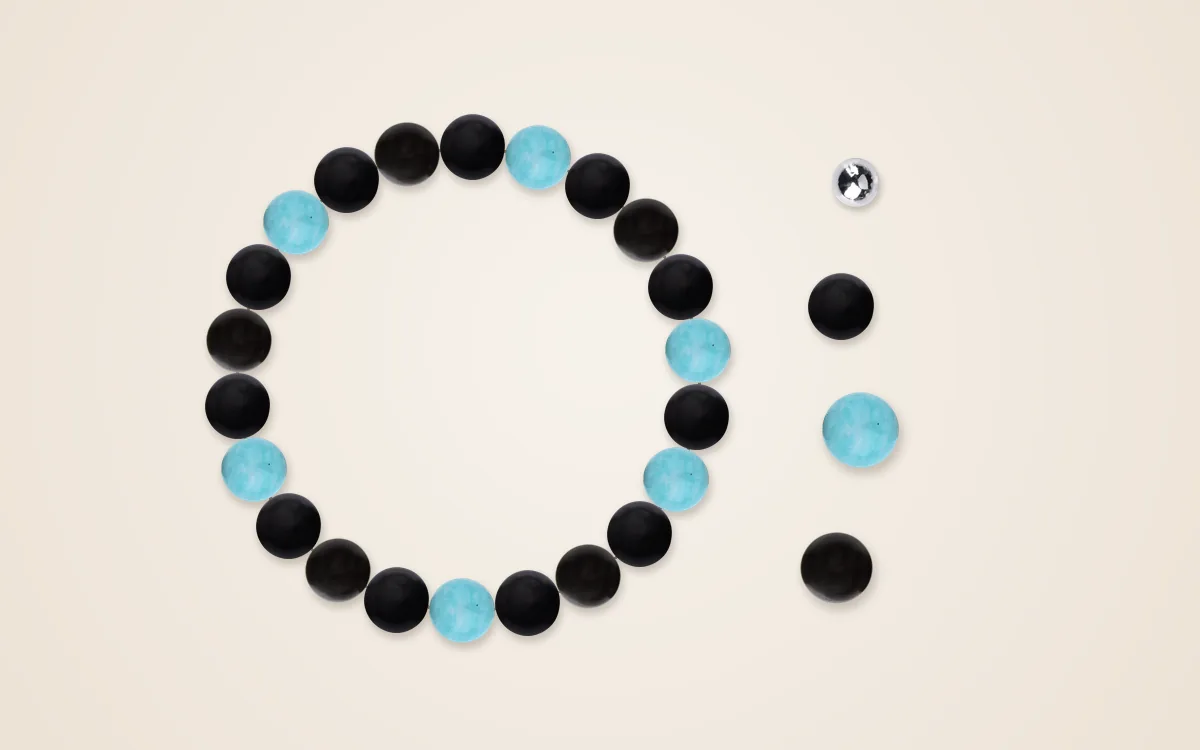
This is the general guide to designing a natural stone bracelet for a man: which stones look at home on his wrist, which bead size suits him, how to size a big wrist, and what the bracelet studio can and can't build. Gift guides for a specific person, like a dad or a groomsman, build on this one.
Use 8 mm beads for most men, 10 mm if his wrist measures 18 cm or more, or 12 and 14 mm for a deliberately bold look, and build from one or two dark or earthy stones such as Smoky Quartz, Black Onyx, Labradorite or Bloodstone. Enter his actual wrist size in whole centimeters; the studio covers 14 to 20 cm and adds about 1.2 cm of ease. The 20-bead build below costs $61.75.
Which stones look right on a man's wrist?
Dark, earthy and grey stones are the safest base for a man's bracelet, because they sit next to a steel watch, a leather strap or a work shirt without pulling focus. These ten from the bead library cover most men's designs:
| Stone | Color | Bead card folklore | Wear note |
|---|---|---|---|
| Smoky Quartz | See-through brown-grey | calm and gentle grounding | Quartz, about Mohs 7; fine with handwashing |
| Black Onyx | Solid black | strength and grounding | Commonly dyed, and the bead card says so |
| Shungite | Deep black | protection and grounding | Softer than quartz, around Mohs 3.5 to 4 |
| Labradorite | Grey with a blue flash | protection and quiet magic | Feldspar, about Mohs 6 to 6.5 |
| Tiger's Eye | Gold-brown with a moving band of light | courage and steady focus | Quartz family; hard-wearing |
| Bronzite | Brown with a bronze shimmer | grounding and calm strength | A little softer than quartz |
| Bloodstone | Dark green with red flecks | courage and vitality | Quartz family; hard-wearing |
| Hematite | Metallic grey | grounding and quiet strength | Best kept dry |
| Red Jasper | Brick red | grounding and stamina | Quartz family; one of the $1.40 beads |
| Sodalite | Navy with white veins | logic and calm thought | About Mohs 5.5 to 6 |
The list is a default, not a rule. If he already wears bright shirts or a colored watch strap, use his colors instead. A man who wears orange sneakers will probably wear Carnelian.
What bead size should a man's bracelet use?
Choose 8 mm for most men and 10 mm when his wrist is 18 cm or larger and he likes some weight on it. Pick 6 mm for a man who rarely wears jewelry, or for a bracelet that will share a wrist with a watch. On an 18 cm wrist the studio gives 32 beads at 6 mm, 24 at 8 mm and 20 at 10 mm.
A 10 mm bead costs 15% more than the listed price, but there are four fewer on an 18 cm wrist, so a one-stone strand still comes out slightly cheaper in 10 mm. Below about 16 cm, 10 mm beads start to look chunky.
Can you get the lava stone, wood or metal bead look?
Not directly. The BVDIY studio builds with natural gemstone beads only, so there's no lava stone, wood, obsidian or metal spacer bead, even though all four are common in men's bracelets. These stones give a similar color, but they are alternatives, not the same material:
- Black lava: Shungite or Black Onyx give the black. Neither has lava's pitted surface or its very light weight.
- Obsidian: Black Onyx is the nearest in look, a glossy, even black.
- Dark wood: Bronzite, Rhyolite or Smoky Quartz give the brown. All three are heavier than wood.
- Metal spacers: one Hematite every fourth or fifth bead gives that metallic grey beat. Hematite is best kept dry.
If lava is what he wants, the lava stone bracelet guide explains what the material is and how it wears.
How many different stones should one bracelet use?
One or two. A single stone around the whole strand is the easiest bracelet for a man to wear, and a second stone used as a sparse accent is as far as most men's designs need to go. A third color usually makes the strand look busy; if you want one, use it as a single center bead.
One stone: for a 20 cm wrist at 8 mm the studio gives 27 positions. Fill all 27 with Bloodstone at $1.80 each and the total is $61.59 with the $12.99 base. From across a room it reads as dark green; up close the red flecks show.
One stone plus an accent: for an 18 cm wrist at 10 mm the studio gives 20 positions. Place four Smoky Quartz, then one Labradorite, and repeat four times. That's 16 Smoky Quartz at $2.07 and 4 Labradorite at $3.91, so the beads cost $48.76 and the bracelet comes to $61.75. Spacing every fifth bead works because 20 divides by 5. On 23 or 26 positions, place the accents by eye and let one gap run a bead longer, where the strand closes.
What if his wrist is bigger than 20 cm?
The studio's largest size is a 20 cm wrist, about 7.9 inches, which takes 27 beads at 8 mm and 22 at 10 mm. A wrist that measures 8 inches (20.3 cm) or more is outside the range, so email [email protected] before ordering instead of entering 20 and hoping it stretches.
Men who lift or work with their hands often measure near the top of the range, so measure rather than guess. Enter the wrist itself, not a watch strap or bracelet length; the studio adds about 1.2 cm of ease on its own. Between sizes, take the larger: a reading of 18.4 cm is entered as 19. The wrist measuring steps cover tape and paper-strip methods.
Should a bracelet go on the same wrist as his watch?
Usually it goes on the other wrist. Quartz beads are about Mohs 7, harder than a steel watch case, so a strand rubbing against the case all day will scuff it. If he wants both on one wrist, 6 mm beads sit lower and catch less, and the bracelet belongs on the elbow side of the watch. More on spacing and stacking is in wearing beads next to a watch.
Buying for someone in particular? The Father's Day bracelet guide works back from real shipping times, and groomsmen bracelet sets covers ordering several at once.
Sources: Hardness of quartz, labradorite, sodalite, bronzite and shungite: Mindat mineral database. Stone meanings are traditional folklore, not health or financial advice.