
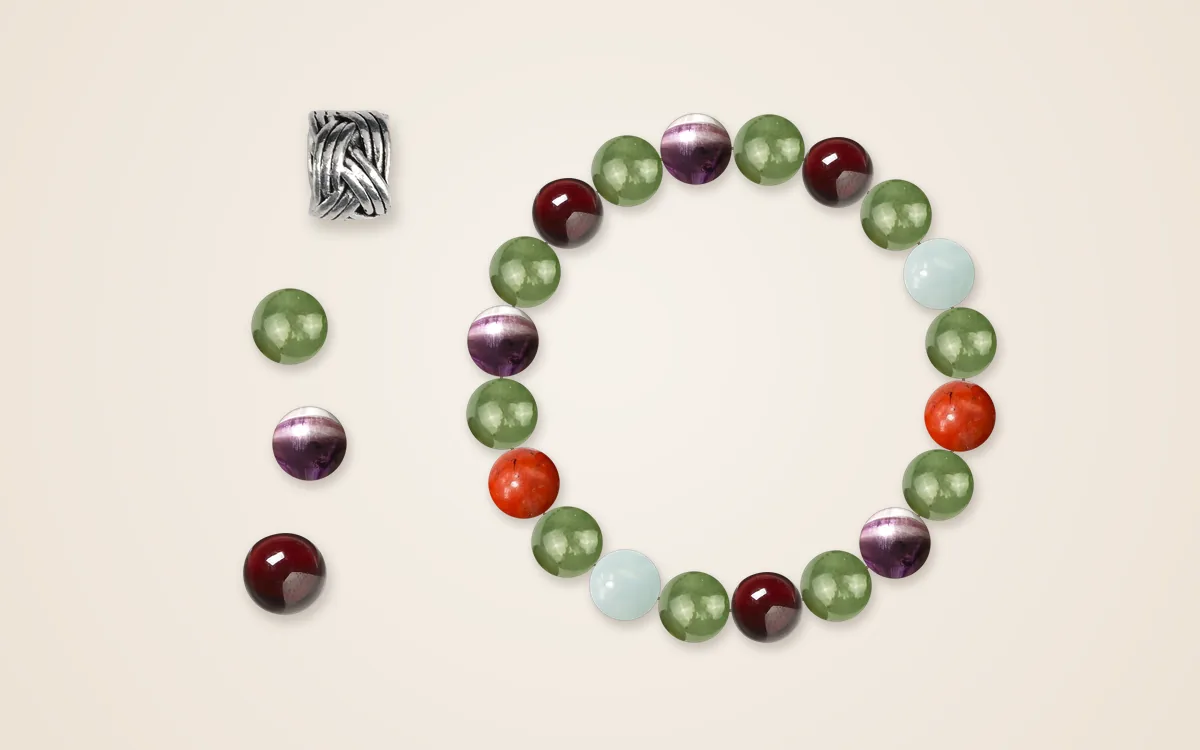
This page is about what the design of a bracelet says, apart from the stones themselves: the colors, how many accent beads there are, what order they sit in, what repeats and where the important bead goes. For what individual stones traditionally mean, use the stone-by-stone meanings guide instead.
Five design choices carry meaning in a beaded bracelet: color, count, order, repetition and placement. The studio sets the total number of beads from the wrist size, so symbolism lives in the accent beads: how many there are (one per person, a lucky number), the order they sit in (birth order, a timeline), what repeats, and whether the key bead faces out or toward the wearer.
What do bead colors symbolize across cultures?
Color is the first thing anyone sees on a bracelet, and its meaning depends on the culture of the person reading it. The same white strand reads as bridal in one family and as mourning in another, so think about who will wear it. Common associations, and stones in the BVDIY library that carry each color:
| Color | Widely recognized associations | Stones in that color |
|---|---|---|
| Red | Luck and celebration in Chinese tradition; love and courage in Western use | Garnet, Red Jasper |
| White | Weddings and new starts in Western tradition; mourning in parts of East Asia | Clear Quartz, Selenite |
| Black | Mourning and formality in Western tradition; strength | Black Onyx, Shungite |
| Blue | Calm and trust; protection against the evil eye in Mediterranean and Middle Eastern custom | Sodalite, Aquamarine, Blue Lace Agate |
| Green | Growth, spring and new beginnings | Green Aventurine, Jade, Malachite |
| Purple | Royalty and dignity, from the days when purple dye was rare and costly | Amethyst |
| Gold and yellow | Sun, warmth and success | Tiger's Eye, Yellow Jasper, Pyrite |
| Pink | Tenderness and gentler kinds of love | Rose Quartz, Rhodonite |
One main color with one accent color is easy to read. Three colors can still work if they stand for three people or three things, but tell the wearer what they mean; nobody guesses a color code.
How can the number of beads carry meaning?
The bracelet studio sets the total number of positions from wrist size and bead size, so the count you control is the number of accent beads. That is where number symbolism goes: one accent per child, one per decade, eight for good fortune.
- Eight: lucky in Chinese tradition, because the word sounds like the word for prosperity. For a 17 cm wrist at 8 mm (23 positions), 8 Jade with 15 Clear Quartz costs $59.39.
- Four: avoided by many people in China, Japan and Korea, because it sounds like the word for death. Use three or five accents in a gift for them.
- Three: used for past, present and future, or for the three members of a small family.
- One per person or per year: the most personal count. Ten accent beads for ten years together means something to the two people who know.
Some full counts are meaningful in their own right. Buddhist and Hindu prayer beads (malas) use 108 beads, and wrist malas usually use 27, 21 or 18, which divide 108 evenly. The studio happens to give exactly 27 positions to a 15 cm wrist at 6 mm and a 20 cm wrist at 8 mm, 21 to a 15 cm wrist at 8 mm and a 19 cm wrist at 10 mm, and 18 to a 16 cm wrist at 10 mm. Don't change your wrist size to hit a number, though; a bracelet that fits matters more than the count.
How does bead order tell something?
Order turns a set of colors into a sequence: who came first, what happened next. A round bracelet has no beginning, so a sequence needs a starting point, and the simplest marker is one bead that differs from everything else.
- Birth order: one stone per child, eldest first, reading clockwise when you look down at your wrist.
- A timeline: a stone for each place you've lived or each year of a relationship.
- A gradient: dark to light can stand for a hard time easing; the reverse for growing strength. Gradients are common in remembrance pieces, and the memorial bracelet ideas show several.
Worked example, a family in birth order: for an 18 cm wrist at 6 mm the studio gives 32 positions. At the front, place five stones for five family members, eldest first: Garnet, Amethyst, Aquamarine, Peach Aventurine, Sodalite, with one Clear Quartz between each. Fill the remaining positions with Clear Quartz, which makes 27 Clear Quartz in all. With the $12.99 stretch base, the total is $68.19. Garnet, Amethyst and Aquamarine happen to be the January, February and March birthstones; the month-by-month birthstone guide covers the others.
What does a repeating pattern say?
Repetition reads as continuity: something steady that goes on, a bond that keeps coming back around the wrist. A strict repeat (two clear, one dark, around the whole strand) looks calm and ordered. Breaking the repeat once draws the eye straight to the break, which is useful when one bead is meant to stand for the wearer among family, or for someone who is gone.
Repetition can also encode a message. Morse code uses two stones, one for dots and one for dashes, with a neutral bead for the gaps. Every bead in the studio is a natural gemstone, so there are no letter beads, but a Morse pattern spells a name or a date without anyone else reading it. The Morse code bracelet guide has the alphabet and spacing rules.
Where should the most important bead go?
Put the bead that matters most at the center front if the meaning is for others to see, and on the inside of the wrist if it's private. Studio stretch bracelets have no clasp, so the strand rotates and placement becomes a habit: you turn the key bead to where you want it each morning.
- Outward, on top of the wrist: a statement to others. A single Garnet on a Clear Quartz strand faces everyone you shake hands with.
- Inward, toward the palm: a reminder only the wearer sees when they look at their hand.
- Mirrored on a pair: two bracelets with the key bead in the same spot, so the pair matches when the two wearers stand side by side.
Some people also give meaning to which wrist they wear it on; the left or right wrist guide covers those customs.
How do you put the five choices together?
Decide what the bracelet stands for in one sentence, then let one or two of the five choices carry it. Using all five at once makes a strand nobody can read. A practical order:
- Write the meaning down: "our three kids", "a year of recovery", "good luck in the new job".
- Choose the base color that sets the mood, often a neutral such as Clear Quartz or Smoky Quartz.
- Set the count and order of the accent beads.
- Decide where the key bead sits and whether it faces out or in.
Worked example, a wrist mala count: for a 15 cm wrist at 6 mm the studio gives 27 positions, the traditional wrist mala count. Use 26 Smoky Quartz and 1 Rutilated Quartz as the marker bead, which stands in for a mala's larger head bead. The total is $65.99. The studio doesn't make tassels or a larger head bead, so the single golden-needled quartz does that job.
Note: Color and number associations on this page are cultural customs, and stone meanings are traditional folklore, not health or financial advice.