
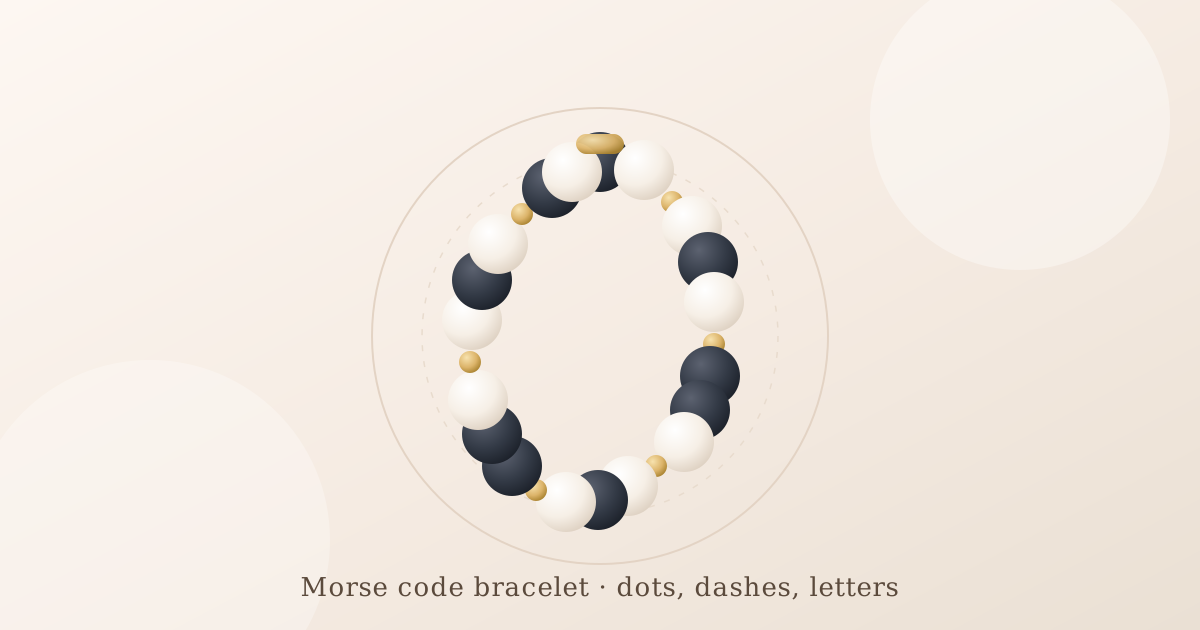
A morse code bracelet looks like a plain beaded bracelet to almost everyone who sees it. To the one person who knows the code, it says something — a name, a date, three words you would rather not say out loud in a meeting. The catch is that the code has to be designed before the bracelet is, because in a morse code bracelet the beads are the message. This guide covers the order that works: choose how dots and dashes will read, decide what they spell, then fit the strand to the wrist so the message stays whole.
Decide the encoding first, then the message, then the fit. The simplest encoding uses two same-size beads in contrasting tones — light for a dot, dark for a dash — with a small metal spacer between letters and a slightly wider spacer between words. Keep it to one word, or two short ones, and stay under roughly 20 encoded letters: a 7-inch bracelet in 6mm beads holds only about 29 beads. Test the contrast in daylight, note the bead order before you string, and check the finished length against your wrist. Build yours bead by bead in the BVDIY bracelet designer, and compare tones side by side in the bead library before you commit.
1. How morse code translates onto a bracelet strand
Morse code is built from two signals and two silences. A letter is a short sequence of dots and dashes; letters are separated by a short gap, words by a longer one.
On a bracelet strand, that becomes:
dot — one bead of the lighter or smaller tone
dash — one bead of the darker or larger tone
letter gap — a small spacer, usually metal
word gap — a wider spacer, or two spacers together
Real morse spacing is variable, and no beaded strand reproduces it exactly — a bracelet only needs to be readable to the two people who know how it was built.
2. Choose your encoding before anything else
There are three workable ways to separate a dot from a dash, and they trade off differently.
Two sizes. A 4mm bead as the dot, an 8mm bead as the dash. This reads from a distance and photographs well, but the large dashes dominate the design, so it suits a statement piece more than an everyday one.
Two tones, same size. A light bead for the dot, a dark bead for the dash, all at 6mm. The most wearable option, and the one most people settle on. What matters is contrast in tone rather than in color name: charcoal and ivory work, while soft pink and lilac do not, because under evening light they read as the same bead.
Position. Encoding a dash as "a bead sitting next to the clasp" sounds clever and is nearly impossible to read. Skip it.
If you want the code to stay private, two tones at the same size is the better choice — to everyone else it looks like an ordinary color-blocked bracelet.
3. Pick beads that keep the message readable
Tone first, color second. The difference between your two code beads matters more than either color. Hold both in daylight and again in a dim room before deciding, and keep the finish consistent — smooth glass reads cleanest, because the code depends on one steady difference rather than two.
Use metal as the divider. Spacers are the punctuation of the bracelet, so they should look like punctuation: small, plain, and clearly different from both code beads. In the bead library, silver generally sits quietly against cool tones and gold against warm ones.
Reserve your accent color. A meaningful accent bead — a birthstone, an initial, a color from a shared memory — belongs outside the coded section, never inside it. An accent that matches one of your code tones reads as a false signal.
4. Decide what it spells
Length is the hard constraint, so choose the message with the bead count in mind.
Word messages. LOVE, HOME, MOM, BEST, or a first name. A short name is often the ideal length: enough beads to be a design, few enough to fit.
Initials. Two or three letters is the lightest option, and the gaps between them can carry the meaning — a good choice for a set of two bracelets.
Dates. A four-digit year is expensive: each digit takes five morse elements, so 20 beads before you add a single spacer. If a date matters, shorten it to two digits or spell the month.
Avoid sentences. A full sentence needs 40 to 60 beads and will not fit a wrist at a wearable size. Three short words such as "I love you" are already 26 encodable beads before spacers. One word gets worn far more often than five.
Want the message visible instead? The quote and message bracelet guide covers letter beads and short phrases.
5. Fit the strand before the final stringing
Do the arithmetic first. Beads needed is roughly your wrist circumference plus ease, divided by bead diameter. A 7-inch finished length is about 44 beads at 4mm, 29 at 6mm, and 22 at 8mm — and every spacer takes the place of one bead.
That is why encoding and fit are connected: a message that fills a 4mm strand will not fit the same wrist in 8mm beads. If the code comes out too long, shrink the bead size or shorten the message — do not stretch the strand, or the bracelet slides.
6mm is the practical middle for a coded bracelet: small enough to hold a short word, large enough to see the difference between two tones. Add a short extension chain so a small sizing error stays fixable. The wrist measuring guide covers both measuring methods, and the bead count guide has the full chart by size.
6. String it in the right order
Write the bead sequence down before you thread anything. The most common mistake is noticing three beads from the end that the message was strung backwards. Lay the beads out in order on a flat surface and read the sequence twice against your notes first.
7. Make it land as a gift
A hidden message is only meaningful if the other person can read it. Without a key, the bracelet looks like a nice beaded bracelet and nothing more.
Include a small card with the message written out and its dots and dashes underneath, so the code can be checked whenever they want. Keep the design wearable too — a neutral base palette, one or two code tones, and a size that suits their wrist.
It suits a long-distance partner, a best friend moving away, a parent, or someone in a hard year who would rather not be asked about it. For a name that should be read at a glance instead, see the name bead bracelet guide.
8. Mistakes worth avoiding
Contrast that is too low. Two pretty colors in the same tone value stop being a code in low light.
No letter spacers. Without a divider, four beads become one run of symbols and the word disappears.
Too many words. A long message forces tiny beads or a stretched strand, and both lose to a short message you can actually see.