
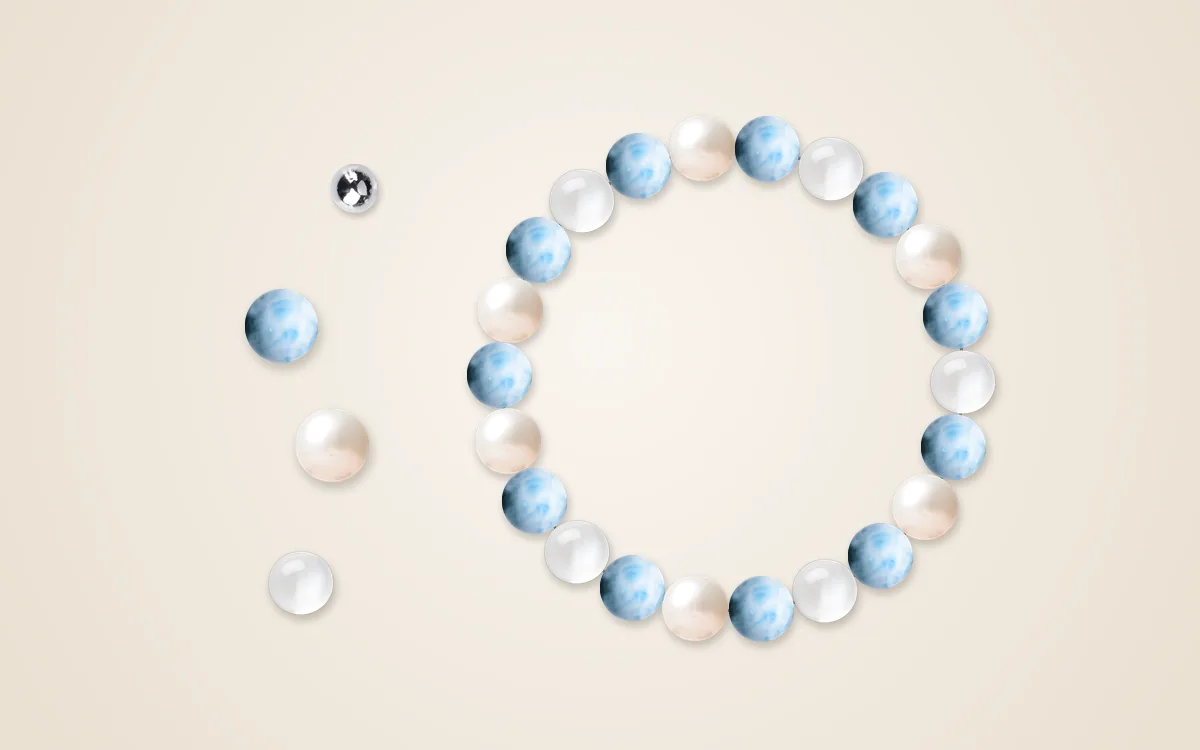
Turquoise is one of the most imitated stones sold as beads, and the words on the label (natural, stabilized, reconstituted, dyed) decide what you're getting. This guide explains those terms, how to spot the common fakes, why turquoise changes color with wear, and how to get a similar blue-green from stones in the BVDIY bracelet studio, which doesn't carry turquoise.
Turquoise is a porous copper mineral, about 5 to 6 on the Mohs scale, that can darken or turn green from skin oils, lotion and water. Most turquoise beads are stabilized with resin, which is normal if disclosed. Cheap, bright blue "turquoise" is often dyed howlite or magnesite. For a similar blue-green today, Apatite is the closest stone in the BVDIY library, as an alternative.
What gives turquoise its color?
Turquoise gets its color from copper, which makes it sky blue, and iron, which pushes it toward green. Chemically it's a hydrated phosphate of copper and aluminum that forms near the surface in dry regions, where water seeping through rock deposits it in veins and nuggets. Important sources include Iran, the U.S. Southwest (Arizona and Nevada in particular) and China; mines in the Sinai supplied ancient Egypt.
The dark lines or patches in many stones are matrix, bits of the host rock (often iron oxide or chert) caught in the turquoise. A fine web of thin dark lines is called spiderweb turquoise and is valued in its own right. Evenly blue turquoise with no matrix, the look often called Persian blue, is the classic high-end color.
What do natural, stabilized, dyed and reconstituted mean?
The label on a turquoise strand tells you how much of the color and strength comes from the stone. In order from least to most processed:
| Label | What was done | What it means for wear |
|---|---|---|
| Natural | Cut and polished only | Rarest and most expensive; most porous, changes color fastest |
| Stabilized | Impregnated with clear resin, color unchanged | The usual bead grade; holds color and polish longer |
| Color-enhanced or dyed turquoise | Resin or dye that also deepens the blue | Real turquoise, but the color isn't its own and can fade |
| Reconstituted | Turquoise chips or powder bonded with resin into blocks | Very even color, cheap; little of it is solid stone |
| Imitation or "block" | Dyed howlite, dyed magnesite, resin or glass | Not turquoise at all |
Under the FTC's jewelry guides, treatments that aren't permanent or that need special care should be disclosed, so an honest seller tells you which row a strand belongs in. Stabilized turquoise is nothing to avoid. It's the realistic choice for a bracelet that gets worn.
How can you tell turquoise from dyed howlite?
Dyed howlite and dyed magnesite are the most common turquoise fakes in bead strands, and both are white stones soaked in blue dye. These checks catch most of them:
- Look in the drill hole. With a phone flashlight, a dyed bead often shows white stone inside, or a ring of darker dye where it pooled.
- Look at the veins. On dyed howlite, dye pools along the grey veins, so they look darker and fuzzy at the edges, as if the blue bled into them.
- Look at the color across the strand. Twenty beads in an identical bright blue, all with similar veining, point to dye.
- The acetone test. Jewelers rub a hidden spot with a cotton swab and a little acetone; blue on the swab means dye. It can damage stabilized turquoise too, so only try it on a bead you don't mind marking.
Howlite also turns up as a fake for lapis lazuli in the same way (the lapis lazuli guide covers that). "African turquoise" is a different case: it's a natural jasper, not turquoise, and it's harder than the real thing.
Why does turquoise turn green, and how do you stop it?
Turquoise turns green or darker because it's porous: it absorbs skin oils, sweat, lotion, perfume and soapy water, and over months the blue shifts. Heat and strong sun can also dry it out and change the color. Untreated turquoise changes fastest; stabilized turquoise changes more slowly but isn't immune.
Some people like that change and consider an aged, greener stone part of its character. If you want to keep the blue:
- Put the bracelet on after lotion, sunscreen and perfume, and let them dry first.
- Take it off for showers, swimming, hand washing and cleaning.
- Wipe it with a soft dry cloth after each wearing. No soaking, no ultrasonic or steam cleaners.
- Store it out of direct sun, away from harder beads such as quartz, which will scratch it.
What is turquoise traditionally associated with?
Turquoise is traditionally associated with protection, travel and good fortune, and it has one of the longest histories of any jewelry stone. It was worn in ancient Egypt, carved in Persia for centuries, and is central to Native American jewelry traditions of the U.S. Southwest. In crystal folklore it's often given to travelers. It makes a good going-away present for that reason, as tradition rather than protection.
It's also a December birthstone, alongside tanzanite and zircon, which makes it a common holiday and winter birthday gift. For the rest of the year, see the birthstone ideas by month.
How do you get a turquoise look from stones in the BVDIY studio?
Apatite is the closest blue-green in the BVDIY library, a teal that sits between turquoise blue and turquoise green. It's an alternative with a similar color, not turquoise, and it's translucent rather than opaque, so it looks a little glassier. Apatite costs $2.20 a bead and its bead card lists motivation and clear expression. It is also fairly soft, about Mohs 5, so keep it away from quartz in a stack.
Full teal strand: for a 16 cm wrist at 10 mm the studio gives 18 positions. Eighteen Apatite cost $45.54, for $58.53 including the $12.99 stretch base.
Southwest-style strand: turquoise is classically set beside red coral, and Apatite with Red Jasper gives a similar contrast. For an 18 cm wrist at 8 mm (24 positions), put 2 Black Onyx at the center for the dark matrix, a Red Jasper on each side of them and another Red Jasper on each side of those, and fill the remaining 18 positions with Apatite. That's 18 Apatite, 4 Red Jasper and 2 Black Onyx, $61.39 in total.
Light hand chain: a hand chain at 17 cm and 6 mm gets 33 positions. Place two Apatite, then one Clear Quartz, eleven times: 22 Apatite and 11 Clear Quartz on the $14.99 hand chain base, for $80.99. The clear beads lighten the teal toward the paler sky blue of a lot of turquoise.
Measure the wrist before you order. The studio takes whole centimeters from 14 to 20, and if you're between two sizes, choose the larger. For more on looking after softer stones, read the bracelet care guide.
Sources: Turquoise composition, sources, treatments and imitations: GIA Gem Encyclopedia. December birthstones: GIA birthstones by month. Hardness of turquoise and apatite: Mindat mineral database. Treatment disclosure: FTC Guides for the Jewelry Industry (16 CFR Part 23).