
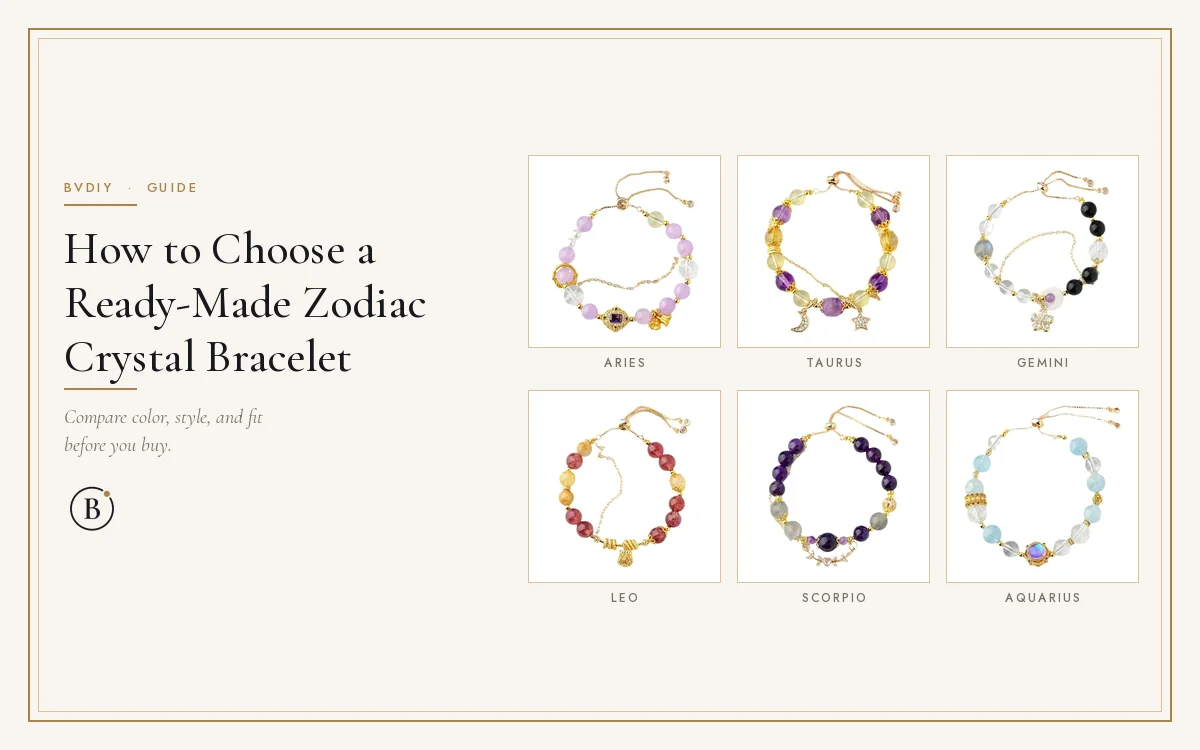
A ready-made zodiac crystal bracelet is a finished beaded strand, not a bead-by-bead studio project, and the stones on it are usually chosen to go with a Western sun sign rather than a scientific rule.
A zodiac crystal bracelet is usually a finished beaded strand whose stones were chosen to go with a Western sun sign, or sometimes a moon or rising sign, not a scientific prescription. There is no official or unified zodiac-to-crystal table, and published lists disagree, so color, style, and an honest description matter more than chasing one “correct” stone. This differs from a birthstone bracelet, which follows calendar months documented by GIA; a sign often spans two months, so the two ideas can point to different stones. Western signs are not the Chinese zodiac and are not the same as astronomical constellations. Before buying a ready-made piece, check wrist size or stretch range, bead size, whether stones are described as treated, and care limits, because many gems should not go in an ultrasonic cleaner or be soaked. These pairings are folklore, not promises of healing, luck, or other guaranteed results.
What People Mean by a Zodiac Crystal Bracelet
When people search for a zodiac crystal bracelet, they usually picture a finished beaded strand — round or faceted beads on stretch cord or a clasp — whose stones are presented as a match for a Western sun sign. This article covers that category only. It does not cover leather cuffs, red-cord knots, charm bracelets, or metal jewelry stamped with a glyph. If a listing says “zodiac bracelet” but shows a disc or charm on a chain, that is a different product type.
Beaded zodiac crystal bracelets are worn by women and by men; the useful differences are wrist size, bead diameter, and style, not a separate mystical rule for each.
Western Signs, the Chinese Zodiac, and Astronomical Constellations
Three systems get mixed together in product copy, and they are not interchangeable.
The Western zodiac used in most English-language jewelry divides the ecliptic into twelve equal 30-degree signs, from Aries through Pisces. Those signs are not the same as the constellations the sun actually passes through. The constellations along that path are uneven in size, and the sun is also in front of Ophiuchus for about two weeks each year, roughly November 30 to December 18; Ophiuchus is not an official horoscope sign. EarthSky’s Ophiuchus explainer is a clear short account of the difference.
The Chinese zodiac is a different tradition: a twelve-year animal cycle recorded by the Hong Kong Observatory (mouse, ox, tiger, rabbit, dragon, snake, horse, goat, monkey, rooster, dog, and pig). It marks years, not monthly sun signs. A Western “zodiac crystal bracelet” almost always means the twelve-sign tropical zodiac. If a piece is built around a year animal, it belongs to another system.
Zodiac Crystals Are Not Birthstones
Birthstones follow calendar months. GIA lists ruby as the July birthstone. A late-July Leo — the sign is often given as about July 23 to August 22, with the exact ingress shifting slightly by year — could also be given a July ruby birthstone bracelet because of the month. Many zodiac-style guides, by contrast, suggest a warm fire-sign palette as a design choice, not an official stone. An early-August Leo shares the sign but falls in August, whose GIA birthstones are peridot, spinel, and sardonyx. The same sign can therefore point to different birthstone options depending on the date.
Zodiac-crystal lists vary as well. One published list may pair a sign with one stone; another list pairs the same sign with a different stone. None of those pairings is a unified standard, and they should not be read as a BVDIY inventory list. A zodiac crystal bracelet and a birthstone bracelet are separate ideas. Choose the system that matters to the wearer, then read the listing to see which stones are actually on the strand.
Why Sign-and-Crystal Charts Disagree — and How to Read a Listing
No governing body assigns crystals to signs the way GIA documents birthstones by month. Books, blogs, and retailers each publish their own pairings from color symbolism, folklore, or editorial preference. Examples you may see in shops — and this is commonly seen, not a rule, and not a recipe to copy — might place a violet stone with one sign in one list and a blue stone with the same sign in another. Treat any chart as a designer’s story, not a scientific table. For folklore context, not medical or financial claims, see our crystal bracelet meanings guide.
When you read a product listing, look for:
- Named stones. The listing should say which beads are on the strand, not only “zodiac stones for Virgo.”
- Honest framing. A careful seller describes the pairing as traditional, symbolic, or inspired by a sign’s element, not as a proven property of the mineral.
- Bead size. Diameter changes how the strand sits, how heavy it feels, and how visible each color is. Compare the stated size with the wrist you measured.
- Closure. Stretch cord slips on; a clasp needs a more precise fit. Our stretch vs clasp bracelets guide covers the trade-offs.
- Treatment disclosure. If beads are dyed, heated, fracture-filled, or coated, the listing should say so. FTC Jewelry Guides advise disclosure when a treatment is not permanent, creates special care needs, or significantly affects value. That is guidance for shoppers to know what to ask, not legal advice.
Do not expect a universal twelve-sign table, and do not treat any seller’s chart as official.
What to Check Before You Buy
### Fit and how to measure
Measure the wrist where the bracelet will sit, usually just above the wrist bone, with a soft tape or a strip of paper. Compare that measurement with the listing’s inner circumference or stretch range. Our how to measure your wrist article walks through the steps, and the size guide is there for reference. Do not assume a single default length will fit everyone, and do not rely on a size label that never states a range or a measurement.
### Treatments and the word “natural”
“Natural” should not be used to dress up a man-made product. FTC Jewelry Guides caution against using words such as “natural,” “real,” or “genuine” to describe industry products that are manufactured or produced artificially. Many colored beads on the market are still cut from natural material and then treated — dyed, heated, or impregnated with oil, wax, or polymer — to change color or apparent clarity. GIA’s overview of gem treatments notes that some treatments are stable in ordinary wear and others need special care. If a listing says “natural” but does not say whether the beads were treated, ask. The crystal bracelet materials guide covers common bead materials and treatments in more detail.
### Care without absolutes
There is no single wash-or-sun rule for every stone. As a cautious baseline, wipe the strand with a dry, soft cloth after wear, and do not soak it or put it in an ultrasonic cleaner unless you know every bead, treatment, and the cord or clasp can handle that. GIA’s notes on ultrasonic cleaners explain why fracture-filled stones, many organics, oil-, wax-, or plastic-impregnated gems, and some heat-sensitive materials should not go in an ultrasonic machine. Some colored stones can also fade in prolonged strong light; check care notes for the specific beads. For a broader routine, see how to clean and maintain a beaded bracelet.
Ready-Made Versus Designing Your Own
A ready-made zodiac crystal bracelet arrives already assembled; you choose from the pairing the maker offers.
As of 13 November 2026, BVDIY’s Shop collection listed a ready-made beaded bracelet for each of the twelve Western signs, including the Aries Zodiac Beaded Bracelet and the Leo Zodiac Beaded Bracelet. BVDIY’s current zodiac product pages do not name specific crystals, so those listings cannot be treated as crystal styles on that basis. They describe decorative beads and metal accents, with an adjustable sliding-chain closure. That wording does not establish whether the beads are or are not crystal, and it does not identify natural crystal or wood. If you want a finished zodiac beaded strand rather than a named-crystal piece, those shop listings are an alternative to check. Use the listing checks above when you are reading a crystal bracelet product page.
If you would rather plan the sequence yourself, our zodiac sign bracelet ideas article is a related design reference — color palettes, sign-number accents, and custom examples — not the next step this shopping guide is trying to push.
The live Shop collection is the place to see what is currently offered, including the ready-made zodiac beaded bracelets noted above. If you are choosing one as a present, see the zodiac bracelet gift guide. This guide does not quote a price or treat any listing as a permanent stock promise.
- GIA birthstones by month
- GIA July birthstone (ruby)
- GIA August birthstones (peridot, spinel, and sardonyx)
- GIA introduction to gem treatments
- GIA 4Cs: gems and ultrasonic cleaners
- FTC Jewelry Guides, 16 CFR 23.24 (treatment disclosure)
- FTC Jewelry Guides, 16 CFR 23.27 (use of “natural” and similar words)
- EarthSky on Ophiuchus, zodiac signs, and constellations
- Hong Kong Observatory: the 12-year animal cycle