
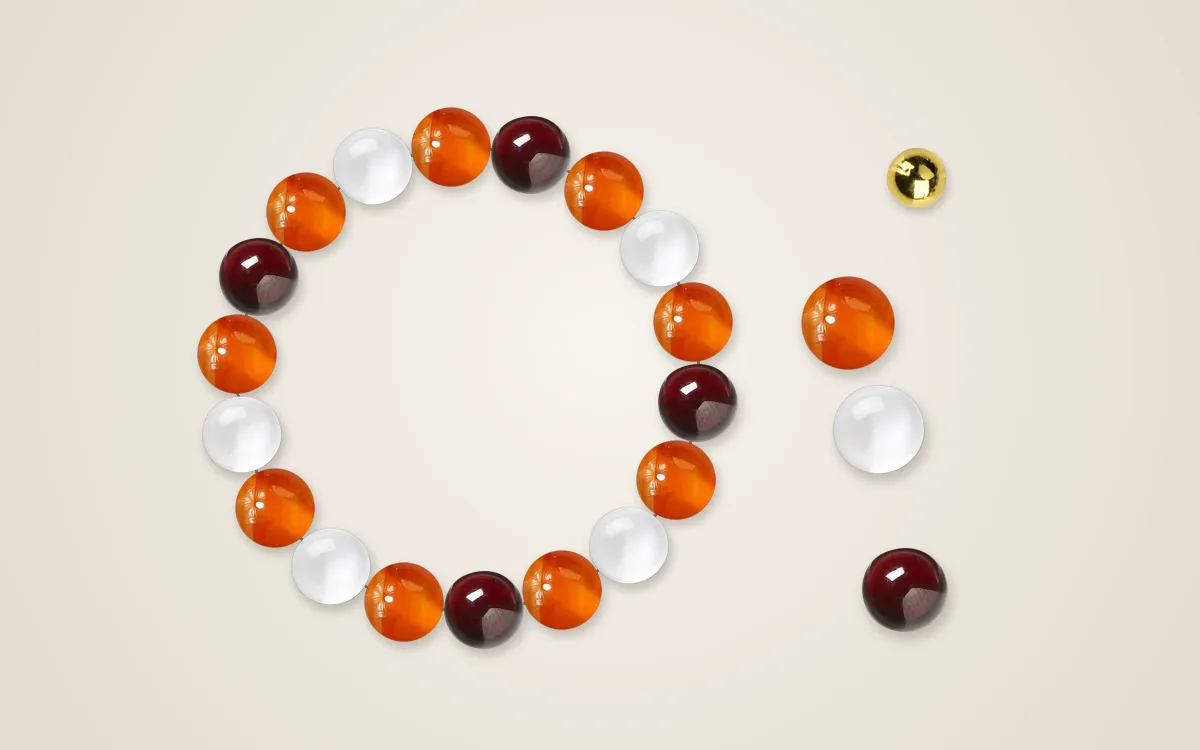
Carnelian is the orange stone with a glow, the one that looks lit from inside when sun hits it. This page covers what carnelian is, why nearly all of it has been heated, how to tell it from dyed agate, what it's traditionally associated with, and three carnelian bracelets you can build and price in the BVDIY studio.
Carnelian is orange-to-red chalcedony, a quartz-family stone about 6.5 to 7 on the Mohs scale, so it handles daily wear. Most carnelian sold today is heat-treated, which is stable. Dyed agate is the imitation to watch for: hold a bead to a window, and dye shows as stripes while carnelian shows cloudy color. A 23-bead sunset strand costs $47.19.
What is carnelian?
Carnelian is a translucent variety of chalcedony, the fine-grained form of quartz that also includes agate and onyx. Its color comes from iron oxide spread through the stone. Pale stones are apricot or honey, the deepest ones a red-brown close to garnet, and most bead strands fall in between, a clear orange.
Because light travels a little way into the bead before bouncing back, carnelian glows where an opaque orange stone just looks flat. That's the main reason to choose it over red jasper or sunstone. Hold a carnelian bead up to the sun and the edges turn almost see-through.
Carnelian is also one of the oldest jewelry stones in use. It was carved for beads and amulets in ancient Egypt and Mesopotamia, and the Romans cut it into signet seals for rings, partly because hot wax doesn't stick to it.
Is carnelian heat-treated or dyed?
Most carnelian on the market is heat-treated, and some "carnelian" is dyed agate. Heating is the old, accepted treatment: it converts yellow-brown iron compounds in chalcedony into red iron oxide, and the color it produces is permanent. The BVDIY bead card for Carnelian lists it as commonly heat-treated, which is the honest description for nearly all carnelian beads.
Dyeing is a different process. Banded agate is soaked in an iron solution or an organic dye, then often heated to fix the color. The stone is real agate, but the color doesn't come from inside it, and dyed beads can fade or bleed over time. A seller should label it dyed agate, not carnelian.
Three home checks, none of them lab-certain:
- Window test: hold the bead against a bright window. Natural and heated carnelian shows soft, cloudy patches of color. Dyed agate usually shows parallel stripes or curved bands, because dye soaks into each agate layer at a different rate.
- Drill hole: look into the hole with a phone flashlight. Dye often collects there as a darker ring.
- Strand uniformity: carnelian beads on one strand vary from paler to darker orange. Twenty beads in exactly the same bright tone suggest dye.
Glass is the other imitation. It's usually easy to rule out: glass carnelian tends to look too even, and under a loupe it may show small round bubbles.
What is carnelian traditionally associated with?
In crystal folklore, carnelian is traditionally associated with courage and motivation, the line on its bead card. In the bead library it sits under the Abundance filter, alongside Green Aventurine, Jade, Pyrite and Sunstone. That makes it an obvious gift before something that takes nerve: a first race, a recital, a new business. Read it as a reminder you chose, not something the stone does.
Carnelian's long history feeds the folklore: a stone that has been worn as amulets and seals for thousands of years picked up protective and lucky associations along the way. Pick it for the color; the history comes with it.
Which carnelian bracelets can you build, and what do they cost?
Carnelian costs $1.60 a bead in the BVDIY studio at 6 and 8 mm ($1.84 at 10 mm), so the price depends mostly on the bead count. Three builds that use carnelian differently:
Sunset gradient stretch bracelet
For a 17 cm wrist at 8 mm the studio gives 23 positions. Put 7 Red Jasper at the front, 5 Carnelian on each side of them, and 6 Yellow Jasper across the back (3 per side). The strand fades from brick red through orange to yellow, which reads as a sunset when the front faces up. Beads: 7 Red Jasper and 6 Yellow Jasper at $1.40, 10 Carnelian at $1.60. Total with the $12.99 base: $47.19. For more warm-season combinations, see the fall bracelet ideas.
All-carnelian hand chain
A hand chain at 15 cm and 6 mm gets 29 positions, since the studio adds about 2.4 cm of ease for a hand chain. Twenty-nine Carnelian beads cost $46.40, plus the $14.99 hand chain base, for $61.39. At 6 mm carnelian looks like a fine line of orange light across the back of the hand, and the small beads keep it from looking heavy.
Smoky men's strand with carnelian accents
For a 20 cm wrist at 10 mm the studio gives 22 positions. Use 16 Smoky Quartz and 6 Carnelian, with the carnelian in two groups of three at opposite sides. That's $44.16 in beads and $57.15 in total. Smoky quartz tones the orange down to a rust accent, which is easier for someone who doesn't wear bright colors. Tiger's Eye works in place of the smoky quartz for a warmer version; the tiger's eye guide has more on that stone.
Which stones go with carnelian, and which clash?
Carnelian pairs best with stones that are either warm and opaque or neutral and clear. The ones that work in the library:
- Clear Quartz: keeps the glow, since light passes through both.
- Smoky Quartz, Tiger's Eye, Bronzite: brown neutrals that make orange look earthy.
- Red Jasper, Yellow Jasper, Sunstone: warm neighbors for gradients.
- Black Onyx: a strong contrast; one onyx bead between each pair of carnelian looks graphic and sporty.
Pink stones are the risky pairing. Rose Quartz and Rhodochrosite next to carnelian can look muddy, because the warm orange makes the cool pink look grey. If you want pink with orange, Peach Aventurine bridges the two. For more on matching stones to skin tone, see choosing bead colors for your skin tone.
How do you care for carnelian?
Carnelian needs the same care as any quartz bead: wipe it after wearing, and wash it now and then in lukewarm water with a drop of mild soap. It's hard enough to scratch softer stones such as malachite, rhodochrosite and selenite if they're stacked against it. The elastic cord, not the stone, is what wears out first, so roll the bracelet on and off instead of stretching it wide.
Measure the wrist before you order: the studio takes whole centimeters from 14 to 20, and between two sizes you choose the larger. The wrist measuring guide has the inch conversions.
Sources: Carnelian as chalcedony, its heat treatment and dyed agate: GIA Gem Encyclopedia. Hardness of chalcedony: Mindat mineral database. Stone meanings are traditional folklore, not health or financial advice.