
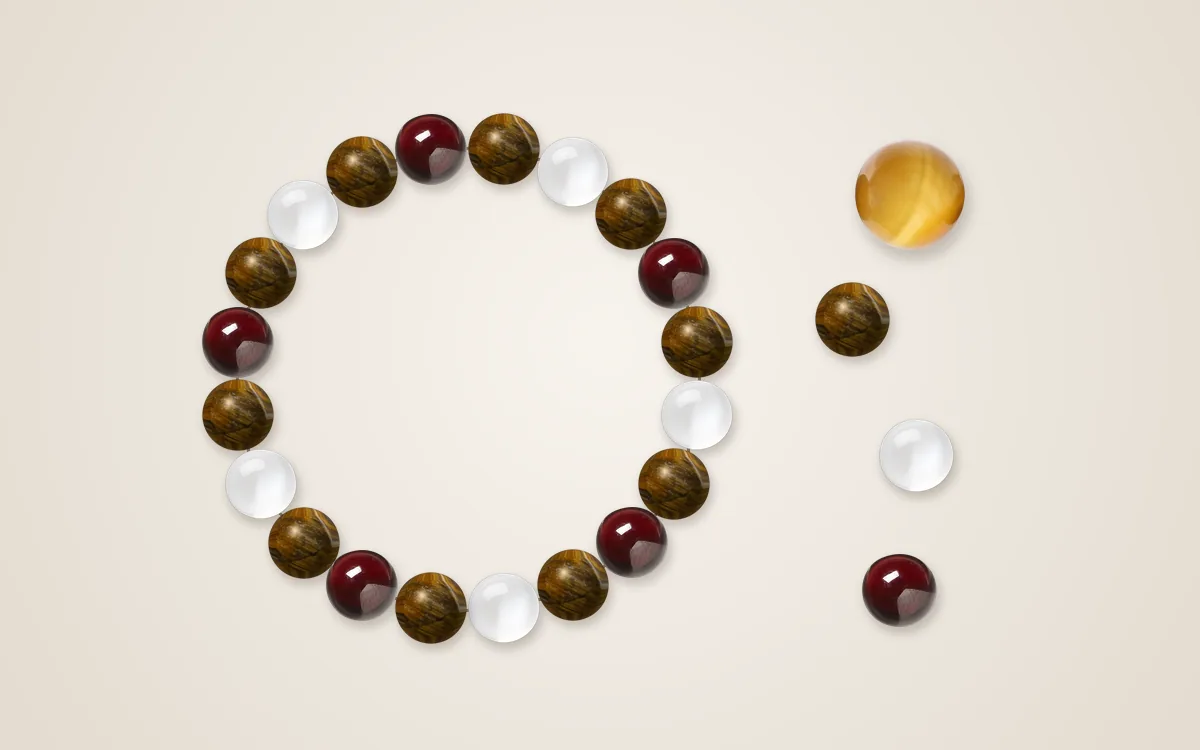
Tiger's eye is the golden-brown stone with a band of light that slides across each bead when you move your wrist. This page explains what causes that shimmer, which colors of tiger's eye are natural and which are treated, what separates a good strand from a dull one, and what three tiger's eye bracelets cost in the BVDIY bracelet studio.
Tiger's eye is quartz with fine parallel fibers inside, which give it a moving band of light called chatoyancy. It rates about 6.5 to 7 on the Mohs scale, so it handles daily wear. Golden tiger's eye is usually untreated; red is heat-treated, and pink, green or purple is dyed. At 10 mm each bead is $2.07, so 20 beads on an 18 cm wrist cost $54.39.
Why does tiger's eye shimmer?
Tiger's eye shimmers because it is quartz packed with very fine, parallel fibers. Light reflects off those fibers in a narrow band at right angles to them, and the band moves as the stone moves. The effect is called chatoyancy, from the French for "cat's eye". The fibers come from an asbestos-type mineral (crocidolite) that was replaced or intergrown with quartz and stained golden-brown by iron oxide. In the polished stone the fibers are sealed inside the quartz.
On a round bead, the band shows as a bright stripe wrapping around the bead, flanked by darker brown. Roll the wrist and the stripe flicks from one side to the other. The effect is strongest under one light source, like the sun or a desk lamp, and weakest under flat ceiling light.
Most tiger's eye on the market comes from South Africa.
Which colors of tiger's eye are natural, and which are treated?
Golden-brown tiger's eye is the natural color, and the other colors are either a different natural variety or a treatment. Here's how they break down:
| Name | Color | What it is |
|---|---|---|
| Tiger's eye (golden) | Honey to dark brown with gold bands | Natural color; usually untreated |
| Hawk's eye (blue tiger's eye) | Blue-grey with a silvery band | Natural: the same fibers before iron staining turned them golden |
| Red tiger's eye (bull's eye) | Red-brown with a coppery band | Golden tiger's eye, heat-treated |
| Pink, green, purple tiger's eye | Bright fashion colors | Dyed; the color can fade |
| Tiger iron | Stripes of gold, red and metallic black | A banded rock of tiger's eye, red jasper and hematite |
The BVDIY Tiger's Eye bead is the golden kind, and its bead card lists no common treatment. If you're comparing it with red tiger's eye elsewhere, the red version has been heated, much as most carnelian is (the carnelian guide explains that treatment).
How do you judge a good tiger's eye bead?
A good tiger's eye bead shows sharp, bright bands that move clearly as you turn it. Grading terms like "AAA" aren't standardized, so judge by eye:
- Band sharpness: crisp gold stripes against dark brown are better than a soft, blurred glow.
- Coverage: on the best beads the shimmer runs all the way around. Lower grades have dull, flat brown patches where the fibers are bent or missing.
- Color: warm honey-gold is the classic. Some beads lean greenish or greyish where the stone is partly hawk's eye, which is natural and some people like.
- Polish: a glassy surface makes the bands brighter. Dull, scratched beads lose most of the effect.
Expect variation on any strand. Some beads will flash more than others, since round beads are cut at random angles to the fibers.
What is tiger's eye traditionally associated with?
In crystal folklore, tiger's eye is traditionally associated with courage and steady focus, the line printed on its bead card, and the studio files it under the Protection filter. The protective idea likely comes from its look. A stone that resembles an eye has long been carried against the "evil eye" in many cultures. Treat it as tradition: the stone doesn't make anyone braver or sharper.
It's also an easy stone for someone who doesn't usually wear jewelry. Brown and gold goes with a watch, denim and work clothes, and it's one reason tiger's eye turns up so often in men's designs. For that angle in more depth, see the men's bracelet guide.
What do tiger's eye bracelets cost to build?
Tiger's Eye costs $1.80 a bead in the BVDIY studio at 6 and 8 mm and $2.07 at 10 mm, plus the $12.99 base for a stretch bracelet. Three builds, each using the stone differently:
All-gold, big beads: for an 18 cm wrist at 10 mm, the studio gives 20 positions. Twenty Tiger's Eye beads cost $41.40, so the total is $54.39. At 10 mm each bead shows a wide band, which is where tiger's eye looks its best.
Brown tonal mix: for a 16 cm wrist at 8 mm, the studio gives 22 positions. Use 12 Tiger's Eye, 6 Smoky Quartz and 4 Bronzite: space the four Bronzite evenly around the strand, and in the gaps use two Tiger's Eye for every Smoky Quartz. The total is $53.39. Smoky quartz is see-through, bronzite has a flatter shimmer of its own, and the tiger's eye bands stand out more next to both.
Gold and navy: for a 19 cm wrist at 6 mm, the studio gives 34 positions. Alternate Tiger's Eye and Sodalite, 17 of each: $1.80 and $1.40 a bead, $67.39 in total. Navy makes gold look brighter, and at 6 mm the strand is slim enough to wear next to a watch. The watch and bracelet guide covers which wrist and which order.
How does tiger's eye hold up over years of wear?
Tiger's eye holds up well. It is quartz, about 6.5 to 7 on the Mohs scale, and fibrous quartz is fairly tough, so it rarely chips at the drill holes. Over a few years of daily wear the polish can get fine scratches from desks and keyboards, which slightly dulls the shimmer. A soft cloth and lukewarm water with a drop of mild soap keep it clean.
Stacking tiger's eye against soft stones such as malachite, rhodochrosite or selenite will scratch them, so keep those on a separate wrist. The stretch cord is the part that wears first: roll the bracelet over the hand instead of pulling it wide, and it will last longer. Before ordering, measure the wrist; the studio takes whole centimeters from 14 to 20, and if you're between two sizes, choose the larger. Bigger beads look bolder but don't change the fit; the bead size guide compares every size from 6 to 14 mm.
Sources: Tiger's eye structure, chatoyancy, hawk's eye and heat-treated red tiger's eye: GIA Gem Encyclopedia. Hardness of quartz: Mindat mineral database. Stone meanings are traditional folklore, not health or financial advice.