
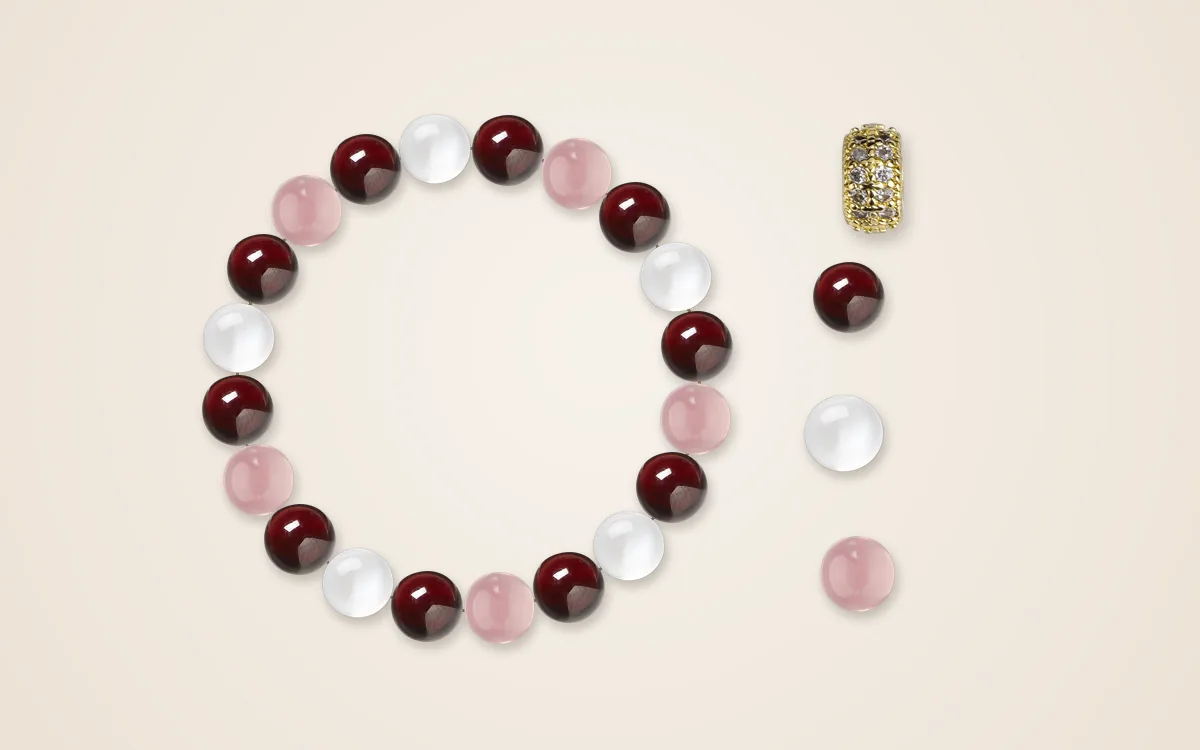
This page is for anyone planning a garnet bracelet, for a January birthday or for themselves. Garnet is the darkest red bead in the BVDIY library and one of the pricier ones, so bead size and how much garnet you use change both the look and the total more than with most stones.
Garnet reads wine red at 6 mm and gets closer to black at 8 and 10 mm, so pick 6 mm if you want the red to show from across a room. At $3.20, a garnet bead costs twice as much as a quartz one. Seven garnets at the front of a clear quartz strand give the color for $60.99 on a 17 cm wrist.
What color is a garnet bead?
A garnet bead is usually deep red with a brown or purple undertone, and it looks darker the bigger it is. Garnet is a group of minerals rather than one stone; the red bead material is mostly almandine or pyrope, the members that run from wine red to near-black red. Light passes only part way into a dark garnet, so a 10 mm bead shows mostly its dark core and a 6 mm bead shows more of the glowing red edge.
In daylight a garnet strand is clearly red. Under a warm indoor bulb or in a phone photo it can look almost black. That matters if the bracelet is meant to read as red at a dinner table. If it's for someone who wears black and grey, the darker look is often what they want.
Which bead size shows garnet best?
Choose 6 mm when the red color is the point, 8 mm for a balanced everyday strand, and 10 mm only if a dark, almost oxblood look is what you're after. Bead size also sets how many garnets you pay for, because the studio fills the strand automatically; the larger sizes also cost a little more per bead.
- 6 mm: a 16 cm wrist gets 29 positions. Fine and bright, with the most beads per strand.
- 8 mm: a 16 cm wrist gets 22 positions. Red in daylight, dark indoors.
- 10 mm: a 16 cm wrist gets 18 positions. Reads as dark brown-red from more than an arm's length away, and starts to look chunky on wrists under 16 cm.
A full strand of 6 mm garnet costs more than a full 8 mm strand on the same wrist, because there are more beads. Enter your real wrist measurement, not a bracelet length; if you're between sizes, round up. The wrist measuring guide takes two minutes, and the bead size comparison goes into look and comfort.
How much does a garnet bracelet cost?
A garnet stretch bracelet costs $12.99 plus $3.20 for every garnet bead, so the total depends mostly on how many of the positions are garnet. The table uses a 17 cm wrist at 8 mm, which the studio gives 23 positions, with Clear Quartz ($1.60) filling the rest.
| Layout | Garnet | Clear Quartz | Total |
|---|---|---|---|
| One garnet at the front | 1 | 22 | $51.39 |
| Front block of seven | 7 | 16 | $60.99 |
| Half and half, alternating | 12 | 11 | $68.99 |
| Full garnet | 23 | 0 | $86.59 |
The front block of seven is the best value of the four: from above it looks like a garnet bracelet, and the clear beads that roll under the wrist cost half as much. For the alternating version, start and end with Garnet so the two garnets meet where the strand closes, not two clear beads.
Smaller beads push the price up, because there are more of them. A full 6 mm garnet strand for a 15 cm wrist uses 27 beads and comes to $99.39, which is just over the $99 free shipping threshold. More price math for other stones is in the custom bracelet cost guide.
Which stones pair well with garnet?
Clear Quartz is the best partner when you want the red to show, because the light coming through the clear beads makes the garnet next to it look brighter. Other pairings change the mood:
- Rose Quartz: pale pink beside wine red. Soft and romantic, and it suits a Valentine's or anniversary gift.
- Smoky Quartz or Bronzite: brown tones that make garnet look warmer and more autumnal. Good for someone who wears earth colors.
- Black Onyx: very dark next to very dark. Indoors the red almost disappears, so use no more than one onyx for every three garnets. Black onyx is commonly dyed, and the bead card says so.
- Red Jasper: opaque brick red at $1.40. Mixing the two gives a tonal red strand for less, though the jasper looks flat beside the garnet's glow.
Carnelian is the one warm stone to keep away from garnet. Bright orange next to wine red tends to look like a mismatch rather than a choice.
Is garnet a good friendship gift as well as a January one?
Yes. Garnet is traditionally associated with devotion and lasting friendship, which is the line on the studio's Garnet bead card, so it suits an old friend as well as a January birthday. The name goes back to the Latin granatum, the pomegranate, whose seeds look like small red garnets. Garnet is also the birthstone for January in the modern list.
For a friend, a matching pair works well: the same garnet front block on two strands, each sized to its own wrist. If you're building a bracelet for a birth month that isn't January, the month-by-month birthstone ideas cover the rest of the calendar. These meanings are folklore, not promises about what a bracelet does.
Is garnet tough enough to wear every day?
Yes. Garnet rates about 6.5 to 7.5 on the Mohs scale depending on the species, close to quartz, and water and mild soap don't hurt it. It can chip if the bracelet is knocked hard against stone counters or a gym bar, so take it off for workouts and heavy cleaning. Wipe it with a soft cloth after wearing, since lotion leaves a haze that makes dark stones look duller.
A stretch bracelet from the studio is on elastic with no clasp, so it rolls on over the hand. Roll it off rather than pulling it wide, which strains the cord. Studio garnet is listed with no treatment on the bead card.
Sources: Garnet species, name origin and January birthstone: GIA Gem Encyclopedia and GIA birthstones by month. Garnet hardness: Mindat mineral database. Stone meanings are traditional folklore, not health or financial advice.