
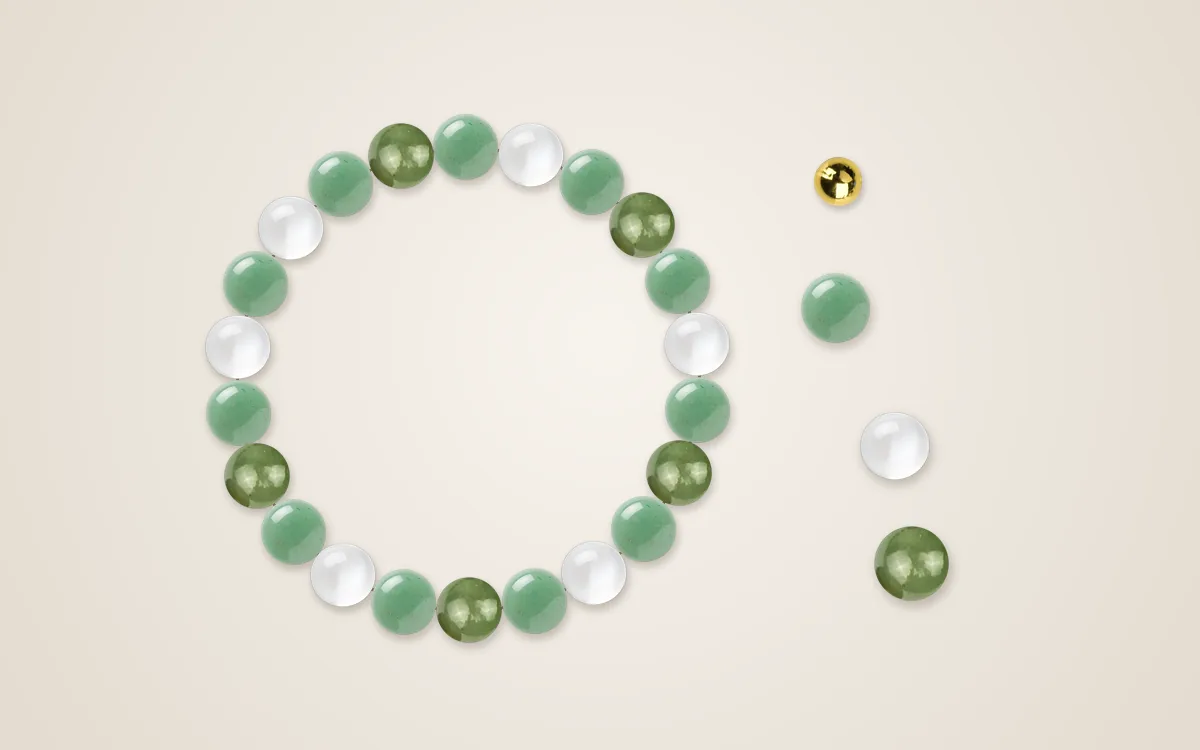
Green aventurine is the stone people choose when they want green on the wrist without paying jade prices. This guide covers what the stone is, how to check that a green bead is aventurine and not glass or dyed quartz, what it's traditionally associated with, and what a green aventurine bracelet costs to build.
Green aventurine is quartz with tiny flakes of green mica that glint as the bead turns. It rates about 6.5 to 7 on the Mohs scale, so daily wear and handwashing are fine. In crystal folklore it's associated with opportunity and luck. At $1.40 a bead it's one of the cheapest stones in the BVDIY studio: 22 beads for a 16 cm wrist come to $43.79.
What is green aventurine, and why does it sparkle?
Green aventurine is a quartz rock (usually quartzite) colored by small plates of fuchsite, a mica that contains chromium. The mica plates act like tiny mirrors, and the glitter they give off has its own name: aventurescence. Turn a bead under a desk lamp and points of light flick on and off. In shade, the same bead looks like flat sage or leaf green.
The stone was named after a sparkly glass, not the other way round. Italian glassmakers called their glittering glass avventurina, from a ventura, "by chance", and the name later passed to the natural stone that looked like it.
Aventurine isn't only green. Depending on the mineral inside, the same kind of quartz comes in peach, orange, blue and grey. The bracelet studio carries two of them, Green Aventurine and Peach Aventurine, and both are quartz-hard. Good green aventurine has an even color and fine, scattered glints. Lower grades look pale and grainy, with patches of white quartz showing through.
How can you tell green aventurine from jade or green glass?
Green aventurine is easiest to identify by its sparkle: under a direct light it shows irregular, scattered glints. Jade has a waxy shine and no glitter at all, and green glass either looks too even or glitters too densely. Hold a bead under a phone flashlight and compare it with the table.
| Bead sold as green | Under a direct light | Color |
|---|---|---|
| Green aventurine (quartz) | Scattered glints from mica flakes, uneven in spacing | Sage to leaf green, often slightly mottled |
| Jade (nephrite or jadeite) | Smooth, waxy or oily shine, no glitter | Uneven, often cloudy or with darker patches |
| Dyed quartz or quartzite | Glassy, little or no sparkle | Too bright; color gathers in cracks and around the drill hole |
| Green goldstone (man-made glass) | Dense, evenly spread glitter that looks metallic | Very uniform from bead to bead |
Sellers sometimes list green aventurine as "Indian jade". That's a trade name: the bead is aventurine, which is fine, but it isn't jade. If jade is what you want, the jade bracelet guide explains nephrite, jadeite and their imitations. In the bracelet studio every bead card names the material and any common treatment, and the Green Aventurine card lists none.
What is green aventurine traditionally associated with?
In crystal folklore, green aventurine is traditionally associated with opportunity and luck. That's the line printed on its bead card, and crystal books often call it a stone of opportunity, which makes it an easy gift before a job interview or an exam. Treat that as tradition: a bead doesn't change the odds of anything.
In the bead library, green aventurine sits under the Abundance filter with Jade, Pyrite, Carnelian and Sunstone. Green also suits a fresh start: a new job, a move, a first apartment, a graduation. To choose stones by their traditional meanings first, see what each crystal stands for.
How much does a green aventurine bracelet cost to build?
An all-green-aventurine stretch bracelet costs the $12.99 base plus $1.40 for each bead at 6 or 8 mm, or $1.61 at 10 mm. Across the studio's wrist range, that runs from $38.75 (a 14 cm wrist at 10 mm, 16 beads) to $63.39 (a 20 cm wrist at 6 mm, 36 beads).
The plain strand: a 16 cm wrist at 8 mm gets 22 positions. Twenty-two Green Aventurine cost $30.80, so the bracelet totals $43.79. It's the simplest green bracelet you can build, and at 8 mm the sparkle is easy to see.
A deeper mix of greens: one shade of green from end to end can look a little flat. For an 18 cm wrist at 8 mm (24 positions), put 2 Malachite at the center, 2 Jade on each side of them, and fill the other 18 positions with Green Aventurine. That comes to $55.39, against $46.59 for the same wrist in green aventurine alone. Malachite is soft, about Mohs 3.5 to 4, so two beads at the front is enough; a whole strand of it scuffs.
Every price above includes the base and nothing else. Shipping is $5.99, or free on orders over $99. For the same math with pricier stones, see the bracelet cost breakdown.
Which stones look good with green aventurine?
Green aventurine pairs best with stones that share its sparkle or tone it down. Peach Aventurine, Clear Quartz, Smoky Quartz and Tiger's Eye are the easy partners.
Two aventurines: Peach Aventurine is the same sparkly quartz in a warm peach, so the two catch the light the same way side by side. A 17 cm wrist at 6 mm gets 31 positions. Alternate the two, starting and ending with green: 16 Green Aventurine and 15 Peach Aventurine, $49.40 in beads and $62.39 in total. At 6 mm the alternation reads as a fine two-tone stripe; at 10 mm it starts to look like candy.
- Clear Quartz makes the green look brighter. One clear bead after every three green ones is plenty.
- Smoky Quartz or Tiger's Eye turn the green toward olive and moss, which suits a men's bracelet or a fall wardrobe.
- Rose Quartz with green aventurine is the classic spring pairing, pale pink against sage.
- Jade works when it's grouped, as in the build above. Scatter jade and aventurine at random in equal numbers and the two greens, close but not identical, look like a mismatch.
Does green aventurine need special care?
Green aventurine needs no special care beyond what any quartz bead needs. It shrugs off handwashing, and a rinse in lukewarm water with a drop of mild soap cleans it. The weak point of a stretch bracelet is the elastic cord, not the stone: roll the bracelet on and off rather than pulling it wide, take it off for hot tubs and chlorinated pools, and store it lying flat.
Quartz is harder than malachite, rhodochrosite and selenite, so a green aventurine bracelet stacked against one of those will scratch it over time. The cleaning and storage guide covers the softer stones. Before ordering, measure the wrist: the studio takes whole centimeters from 14 to 20, and if you're between two sizes, choose the larger.
Sources: Aventurine composition, fuchsite inclusions and the origin of the name: GIA Gem Encyclopedia. Hardness of quartz and malachite: Mindat mineral database. Stone meanings are traditional folklore, not health or financial advice.