
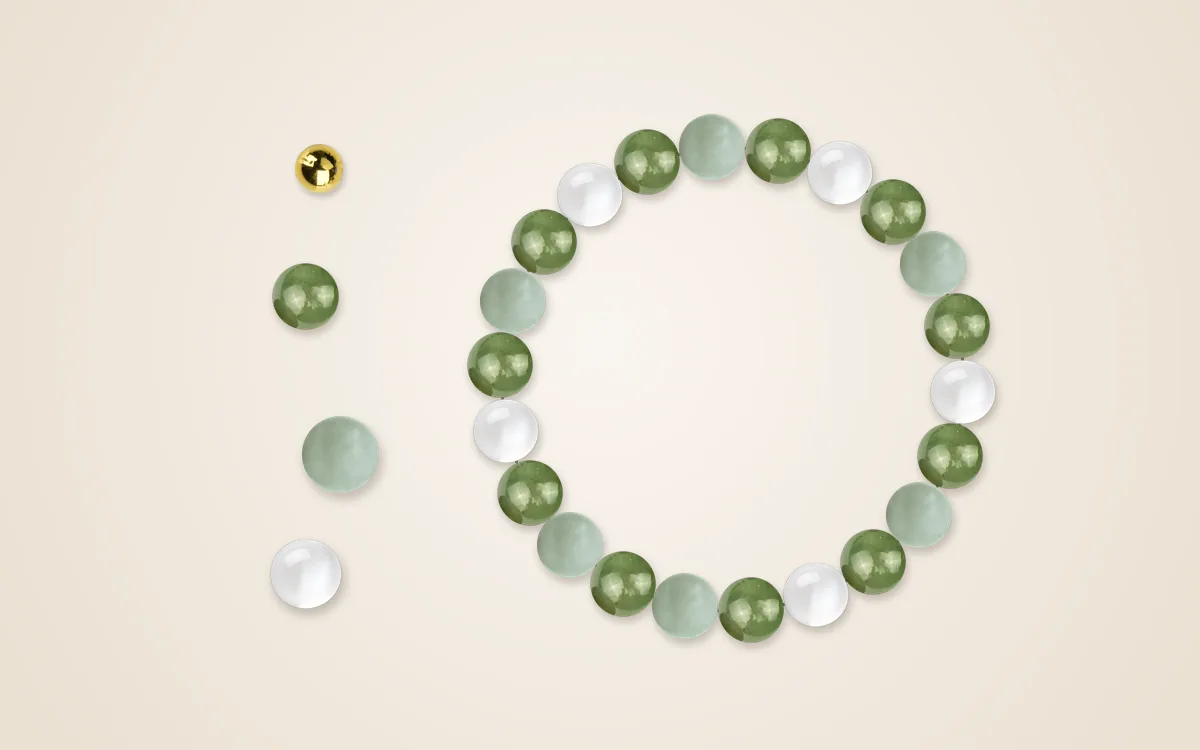
"Jade" is one of the most loosely used words on bead labels, and plenty of green beads sold as jade are something else. This page explains what real jade is, the names that signal an imitation, how a bead bracelet differs from a carved bangle, and what three jade designs cost in the BVDIY bracelet studio.
Real jade is one of two minerals: nephrite (about 6 to 6.5 on the Mohs scale) or jadeite (about 6.5 to 7). Both are exceptionally tough, so jade beads rarely chip. Names like "Malaysian jade", "new jade" or "Indian jade" mean dyed quartz, serpentine or aventurine. In the studio, Jade costs $2.80 a bead; a 16 cm wrist at 6 mm takes 29 beads for $94.19.
What counts as real jade?
Jade is a name for two different minerals that look alike and have been carved for thousands of years: nephrite and jadeite. Both are accepted as jade by gemologists. Anything else sold as jade, however green, is a different stone.
- Nephrite is made of interlocking fibers of an amphibole mineral. That structure gives it a toughness few stones match, plus a soft, oily luster. Most nephrite is spinach to olive green, creamy white or grey. It's the jade of most traditional Chinese carving.
- Jadeite is a pyroxene, slightly harder and denser, with a glassier shine when polished. It comes in green, lavender, white, black and other colors. The finest translucent emerald-green jadeite, mostly from Myanmar, is among the most expensive gem materials in the world.
Hetian jade is a name for nephrite from the Hotan region of Xinjiang, famous for white and pale green material. The studio doesn't carry Hetian jade by name, and the Jade bead card lists no common treatment.
Which jade names on a label mean an imitation?
Trade names with a place or the word "new" in front of "jade" usually mean the bead is another stone. These are the ones that turn up most often:
| Name on the label | What it usually is | How to spot it |
|---|---|---|
| Malaysian jade | Dyed quartz or quartzite | Very bright, even color; dye collects in tiny cracks |
| New jade, Korean jade | Serpentine (bowenite) | Yellow-green, softer, scratches more easily |
| Indian jade | Green aventurine | Glints under a direct light from mica flakes |
| Mountain jade, "jade" in odd colors | Dyed dolomite or marble | Soft; colors look too bright and fade near the drill hole |
| Jade glass, Peking glass | Glass | Small round bubbles under a loupe; colors look too even |
None of these is a bad bead in itself. Green aventurine, for instance, is a hard, attractive quartz (the green aventurine guide covers it). The problem is paying jade prices for them.
Jadeite has its own treatment grades, used mostly in the bangle trade. Type A is untreated. Type B has been bleached with acid and filled with polymer, which can turn brittle and yellow with age. Type C is dyed. Type B and C are common in cheap "jadeite" bangles, so a seller who lists the grade is being straight with you.
Is a jade bead bracelet different from a jade bangle?
A jade bead bracelet and a jade bangle carry the same stone and tradition, but they fit and wear differently. A bangle is one solid ring carved from a single block, sized so it just squeezes over the knuckles, and in East Asian families it's often a gift from a parent or grandparent meant to be worn for decades. Getting it on can take soap and patience, and a hard knock can crack it.
A bead bracelet is sized to the wrist, rolls on over the hand, and survives a drop because each bead is small. It's also far cheaper, since there's no need for a large flawless block. If you love the look of jade but don't want the risk of a bangle, beads are the practical route.
The tradition comes with either one. In East Asian culture jade is associated with good fortune, harmony and virtue, and the Jade bead card in the studio uses that same line. Those are cultural meanings, and for many families they are the whole reason jade gets handed down.
What do jade bracelets cost to build in the studio?
A jade bracelet in the studio costs the $12.99 stretch base plus $2.80 for each Jade bead at 6 and 8 mm; a 10 mm Jade bead is $3.22. The number of beads is set by your wrist and bead size. Three designs that work:
Fine all-jade strand: a 16 cm wrist at 6 mm gets 29 positions. Twenty-nine Jade beads cost $81.20, so the bracelet totals $94.19. At 6 mm the strand is fine and even, light enough to wear every day.
Jade with clear quartz: a 19 cm wrist at 10 mm gets 21 positions. Place two Jade, then one Clear Quartz, seven times: 14 Jade and 7 Clear Quartz, $57.96 in beads and $70.95 in total. The clear beads lighten a dark spinach green, and 10 mm suits a larger wrist without looking heavy.
A matching necklace: the beaded necklace starts at an $18.99 base. At 16 in with 6 mm beads, the studio gives 33 positions; all Jade costs $92.40 in beads, for $111.39. Ordered together with the fine strand above, the set is well over the $99 free shipping threshold. For choosing a length, see the necklace length guide.
Jade is mid-priced in the library: more than Green Aventurine at $1.40, well under Rutilated Quartz at $6.20. The full price breakdown compares stones across sizes.
Which bead size and partners suit jade?
Jade looks most traditional at 6 mm and most modern at 10 mm. At 6 mm a strand reads as a fine, even line of green; at 10 mm the cloudy patterns inside each bead become visible, and the bracelet looks chunkier. On wrists under 16 cm, 10 mm jade starts to look heavy. The bead size comparison shows the sizes side by side.
Good partners for jade in the library:
- Clear Quartz keeps the green fresh and lightens dark jade.
- Garnet gives a deep red against green. Two or three garnet beads at the front are enough.
- Smoky Quartz or Bronzite push jade toward an earthy, understated look that suits men's wrists.
- Green Aventurine next to jade can look like a near miss, two greens that don't quite match. Group them in blocks rather than alternating.
Jade is tough enough for everyday wear. Clean it with lukewarm water and a drop of mild soap and dry it with a cloth. Before ordering, measure the wrist; the studio takes whole centimeters from 14 to 20, and if you're between two sizes, choose the larger.
Sources: Nephrite and jadeite, jade imitations and jadeite treatments: GIA Gem Encyclopedia. Hardness of nephrite and jadeite: Mindat mineral database. Stone meanings are cultural tradition, not health or financial advice.