
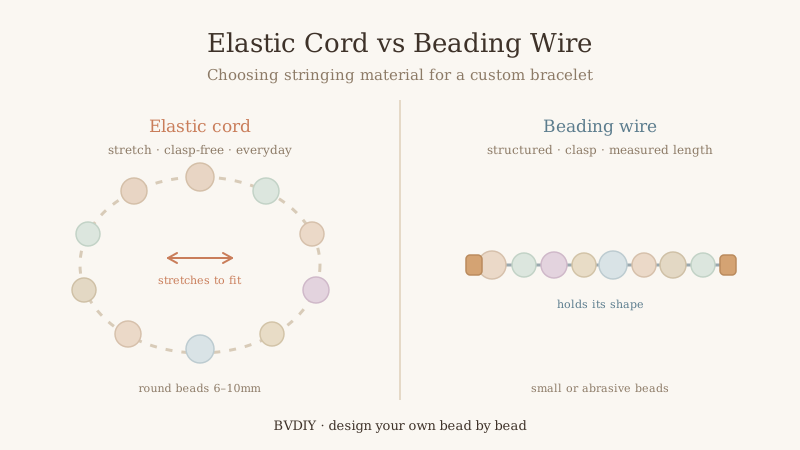
A bracelet is only as good as the thread running through it. You can choose a perfect palette and still end up with a strand that sags, stretches out, or snaps within a month — because the stringing material was picked out of habit rather than on purpose. Here is how elastic cord, beading wire and thread each behave on the wrist, and how to match the material to the bracelet you are designing.
How each material behaves on the wrist
The three common options differ less in strength than in movement. Elastic cord stretches and recovers, so it flexes with every wrist movement and never needs a clasp. Beading wire barely stretches at all, so the strand keeps the exact shape and drape you strung it with. Nylon thread has a little give but mostly holds its line, which is why it appears in delicate, closely strung work.
Elastic cord: when stretch is the right answer
Elastic cord is the default for beaded bracelets for good reason. It removes the clasp, which removes the hardest part of sizing, which means the bracelet goes on without help and comes off without thought. For everyday pieces built from 6mm to 10mm round beads, it is usually the best choice. It does have limits worth knowing before you commit.
- It ages. Elastic relaxes with heat, sweat and sunlight. A well-made elastic bracelet typically needs restringing within a year or two of daily wear, sooner if it is worn in the shower or swimming.
- Sharp holes cut it. Beads with rough or narrow drill holes act like a saw against the cord. Faceted crystal, raw stone and some metal beads are abrasive inside.
- It wants round beads. Large, flat or unusually shaped beads can leave gaps in an elastic strand that no amount of knotting will remove.
- Heavy centrepieces pull. A pendant on an elastic strand will stretch the cord right where it hangs.
For elastic designs, use a cord that matches the drill hole — thick enough to fill it, thin enough to pass through twice — and allow a comfortable, not snug, fit. If the cord is visibly visible in the gaps between beads, it is too thin for that bead size.
If you are still deciding how the bracelet closes, our guide to stretch versus clasp bracelets covers that trade-off in detail.
Beading wire: when structure matters more
Beading wire is a thin, multi-strand steel cable, usually nylon-coated, that is strung with a clasp. Nothing about it stretches, so the bracelet keeps its designed length and shape for years, even under daily wear and heavy beads.
Reach for wire when:
- Beads are small or irregular. 4mm and smaller beads, seed beads, and mixed shapes hold a straight line far better on wire.
- Beads are abrasive. Crystal, lava stone, metal and raw-cut stone will not chew through wire the way they chew through cord.
- You want a charm or pendant. A heavy centrepiece hangs properly on wire and stays put.
- You want a precise drape. Structured, layered and dressier designs read better when the strand does not flex.
The trade-off is finishing. Wire needs a clasp, crimp beads or a wire guard, and it works best slightly loose rather than taut — a wire bracelet strung too tight will kink. It also demands accurate sizing, since there is no stretch to absorb a mistake. Measuring carefully matters here; our wrist measuring guide covers measuring for a fixed-length bracelet.
Nylon thread and silk cord, briefly
Nylon thread is strong, soft on the beads and barely visible through small holes, which makes it the classic choice for delicate, closely strung work. Silk cord is a traditional option for knotted designs, where a knot sits between each bead. Both are strung with a clasp and both suit lighter designs — they are happiest with beads up to roughly 8mm and bracelets meant to be worn gently rather than daily.
Matching the material to your beads
Three checks settle almost every case.
- Drill hole size. Every bead passes onto the strand twice in most designs. If the hole will not take the material twice, size down or change material.
- Bead weight. Heavier beads and centrepieces want wire. Light, uniform beads are comfortable on elastic.
- Abrasion. If the beads feel rough or look sharp-edged at the hole, use wire. Elastic will fail there first.
You can browse the bead options and check hole sizes on each material before you commit in the bead library.
What this changes in your design
Once the material is fixed, the rest of the design gets easier. Elastic means you can lean on a comfortable overall length and skip the clasp work. Wire means the length has to be exact and the closure becomes part of the design, not an afterthought. Neither choice is better in the abstract — a stretch bracelet and a wire bracelet built from the same beads will simply feel and last differently.
If the bracelet is a gift, choose the material you would want on your own wrist given how the person wears jewelry: daily and casually points to elastic; occasionally and dressy points to wire.
When you are ready, you can design your bracelet bead by bead, choose the stringing material, and see the finished length and preview before ordering.
Ready to build it? Pick your beads, choose your stringing material and see your bracelet come together bead by bead.