
A matching mother-daughter bracelet set is one of the most personal gifts you can design — and the good news is that it does not have to be two identical copies of the same bracelet. The sets people actually wear are the ones that share a clear visual connection while fitting each wrist and each personality. This guide walks through how to design a mother-daughter pair at BVDIY: choosing what to share, adding birthstones or initials that make each one personal, sizing two different wrists correctly, and building both designs bead by bead in the designer.
Design mother-daughter matching bracelets by choosing one shared element — the same color palette, base bead, or metal finish — and then personalizing each bracelet for its wearer. Use each person's birthstone as accent beads, add an initial or two, and size each bracelet to the wrist it belongs to (a daughter's smaller wrist usually suits 6mm beads, while an adult wrist can take 8mm or 10mm). Build both designs separately in the bracelet designer, where the price updates live as you add each bead, and you will have a connected pair that still feels like two individual bracelets.
Start with what the pair will share
The secret to a set that looks intentional is deciding what connects the two bracelets before you start adding beads. You only need one strong shared element — more than that and the designs start to feel crowded. Three approaches work especially well.
Shared color palette. Choose two or three colors that suit both of you, and use the same palette on both bracelets, but in slightly different arrangements. One might lead with rose and use gold as an accent; the other can reverse it. The pair clearly belongs together without being twins.
Shared base bead. Both bracelets built on the same base — the same glass, wood, stone, or pearl bead — instantly read as a set. From there, the accents can differ freely. This is the easiest approach and almost always looks cohesive.
Shared metal finish. Gold, silver, or rose-gold spacers and clasp on both designs tie two otherwise different bracelets together. It is the subtlest of the three, and pairs beautifully with birthstones or initials as the personal detail.
Browse the full range of bases and accent options in the bead library to see what is available before you commit to an idea.
Make each bracelet personal
Once the shared element is set, the fun part is making each bracelet belong to its wearer. The details that work best for mother-daughter sets are the ones with a story attached.
Birthstones. Use each person's birth month as a crystal accent segment, or use the daughter's birthstone on both bracelets so the pair tells one shared story. Birthstone-toned crystal beads sit naturally alongside glass, wood, or pearl bases and add meaning without dominating the design.
Initials. A short letter-bead segment marks whose bracelet is whose. Keep it to one or two beads so it reads as a signature detail rather than the whole design.
A shared symbol. A heart, a small charm, or a repeated spacer pattern can carry the connection between the two designs — the same symbol placed in the same position on each bracelet makes the pairing feel deliberate.
Size each bracelet to its wrist
Mother and daughter rarely have the same wrist size, and the fit is what makes a bracelet comfortable enough to actually wear. Measure each wrist separately with a flexible tape or a piece of string laid flat against a ruler, then add a little ease — most people like their beaded bracelet to sit snug but not tight.
A younger daughter's wrist is often around 5 to 5.5 inches, while most adult wrists fall between 6.5 and 7.5 inches. The bead size matters here too: 6mm beads suit smaller wrists beautifully, while 8mm or 10mm beads have more presence on an adult wrist. That means the two designs can use different bead sizes and still share the same colors — often the smartest way to make a pair that fits both of you properly.
If you are unsure about measurement, the extension chain on the clasp gives you a little room to adjust, and most designs can be tweaked after measuring. The designer makes it easy to build each bracelet to its own length, so size each one for the wrist it belongs to rather than assuming one length fits both.
Build both designs bead by bead
With the plan in place, design the two bracelets one at a time. Start with the shared element — the base bead or color palette — then add each person's personal details. Because the price updates live as you add beads, you can experiment freely: add a birthstone, remove a spacer, swap a color, and watch how each choice changes the look and the total.
Two practical tips from our design team: lay the two designs out and compare them side by side before ordering, and check that the shared element actually reads as shared — if the palettes have drifted apart, pull them back together with a few common beads or spacers. A set that takes ten minutes to refine will be worn for years.
A simple example set
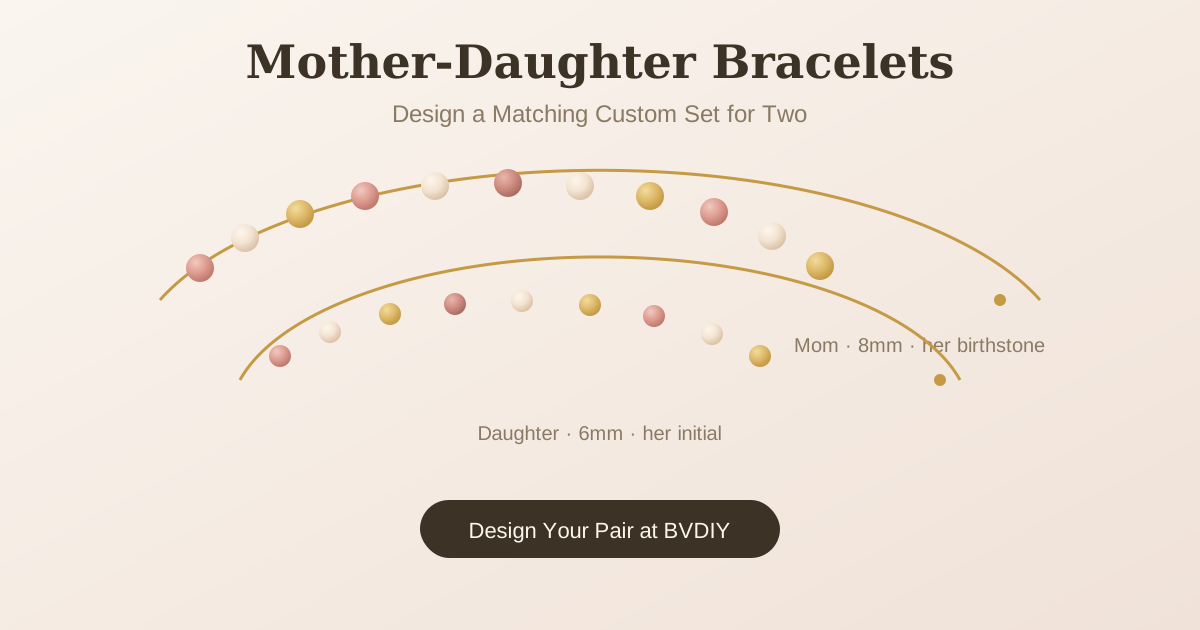
To make this concrete, here is a classic mother-daughter design. Both bracelets use a glass base in the same dusty rose and cream palette, with gold-tone spacers. The mother's bracelet is 8mm beads sized to a 7-inch wrist, with her birthstone as a four-bead accent. The daughter's is 6mm beads sized to a 5.5-inch wrist, with a single birthstone accent and one letter bead for her initial. Same palette, same metal, same story — but each one fits and belongs to its wearer. Build your own pair in the designer and compare the two side by side as you go.
Related guides: How to Design a Custom Bracelet for Your Daughter and How to Design a Custom Bracelet for Mom.