
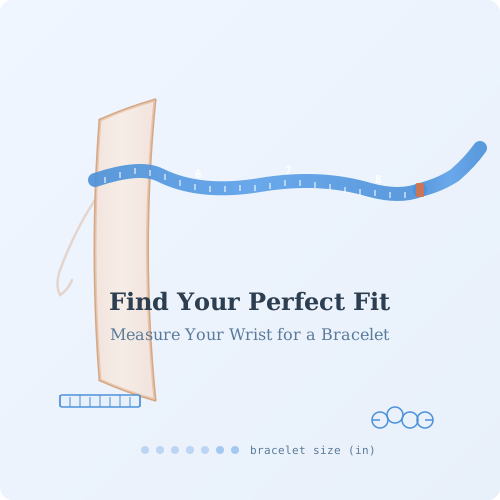
A well-fitted bracelet feels like it belongs on your wrist — not too tight, not sliding around, just naturally comfortable. That fit starts before you choose beads or colors. It starts with a simple measurement. Whether you are designing a bracelet for yourself or as a gift, knowing how to measure your wrist is the single most important step to ensure the finished piece fits the way it should. This guide covers four easy methods, a size chart, and practical tips for getting the most accurate reading every time.
Wrap a soft tape measure snugly around your wrist just below the wrist bone. Write down that number, then add 0.25 to 0.75 inches depending on your preferred fit — snug (add 0.25 in), comfortable everyday (add 0.5 in), or relaxed (add 0.75 in). That final number is your bracelet size. No tape measure? Use a string or paper strip, mark the overlap, and measure it against a ruler.
Why the right size matters
A bracelet that is too tight feels restrictive and can pinch or catch on clothing. A bracelet that is too loose slides over the hand and risks falling off, especially with heavier beads. The right size sits comfortably without spinning — it moves with you throughout the day but stays in place when you put your hand down.
Getting the size right is especially important for custom bracelets. Because each piece is made to order, you cannot exchange it like a store-bought bracelet. A good measurement upfront saves the trouble of resizing later.
Method 1: Using a soft tape measure
A flexible sewing tape measure is the easiest and most accurate tool. Wrap it around your wrist at the narrowest point — just below the wrist bone on your pinky side. Pull it snug but not tight; the tape should sit against your skin without compressing it. Note where the "0" end meets the tape. This is your wrist circumference. Add 0.25 to 0.75 inches for comfort room based on the fit you want. For a 6-inch wrist with a comfortable fit, for example, your bracelet size is 6.5 inches.
Method 2: String or paper method
No tape measure? A piece of string, thin ribbon, or paper strip works nearly as well. Wrap it around your wrist just below the bone, mark where it overlaps, then lay it flat against a ruler. That is your wrist circumference. Add comfort room as above. The most common mistake is not pulling the string snug enough — it should sit against your skin the way a bracelet would, without denting the skin or sliding freely.
Method 3: Printable bracelet sizer
Many custom jewelry studios, including BVDIY, offer printable bracelet sizers you can download and print at home. These pre-marked paper strips wrap around the wrist like a tape measure. They are especially useful for double-checking your tape measure reading or for estimating someone else's size as a gift. When printing, set your printer to 100% scale (not "fit to page") and verify the calibration line against a real ruler before cutting.
Bracelet size chart
Wrist 5.5 in → Bracelet 6.0 in (snug), 6.25 in (standard)
Wrist 6.0 in → Bracelet 6.5 in (snug), 6.75 in (standard)
Wrist 6.5 in → Bracelet 7.0 in (standard), 7.25 in (relaxed)
Wrist 7.0 in → Bracelet 7.5 in (standard), 7.75 in (relaxed)
Wrist 7.5 in → Bracelet 8.0 in (standard), 8.25 in (relaxed)
Wrist 8.0 in → Bracelet 8.5 in (standard), 8.75 in (relaxed)
These are guidelines, not rules. If you know you prefer looser bracelets, add more room. The most common bracelet sizes ordered at BVDIY are 7 inches (small to average wrist) and 8 inches (average to larger wrist).
How bracelet style affects sizing
The same wrist can require slightly different sizes depending on the bracelet style. Beaded bracelets on stretch cord fit best with 0.25 to 0.5 inches of extra room — too much room and the bracelet spins. Beaded bracelets on wire with a clasp benefit from 0.5 to 0.75 inches of extra room. Chain bracelets with an extender chain are the most forgiving, offering 1 to 2 inches of adjustment range. Heavy beads tend to stay in place better with a slightly snugger fit.
When choosing your bead materials, browse the BVDIY bead library to see bead sizes and finishes before deciding on your fit preference. Larger beads create a bolder look, while smaller beads give more design flexibility.
Measuring someone else (gift sizing)
If you are designing a bracelet as a gift, the most accurate method is to borrow an existing bracelet that fits the recipient well. Lay it flat and measure the inside length from end to end — that is their bracelet size. If that is not possible, check with a close friend or family member. As a last resort, use standard sizes: 7 inches for most women, 8 inches for most men. An extender chain adds flexibility if your estimate is slightly off.
Common measuring mistakes
Three errors cause most sizing problems. Measuring over the wrist bone instead of below it gives a larger number than needed. Pulling the tape too tight compresses the skin and gives a smaller reading. And forgetting to add comfort room — your wrist measurement is not your bracelet size. A metal tape measure should also be avoided, as it does not conform to the wrist's curve and gives a longer reading.
From measurement to bracelet design
Once you have your bracelet size, you are ready to design. The size determines total bead count, which affects your pattern and layout. In the BVDIY bracelet designer, you start by selecting your size, then build the layout bead by bead. The tool shows the complete bracelet so you can see exactly how the fit, pattern, and colors come together before you order.