
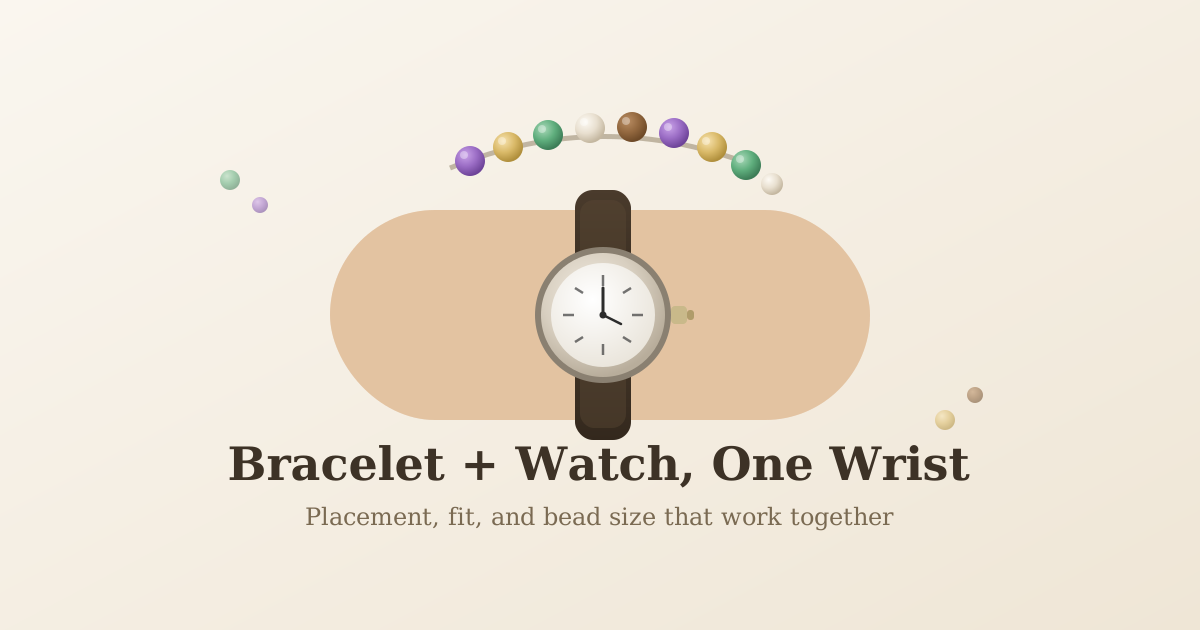
People often ask which wrist a crystal bracelet “should” go on. The useful answer is the wrist where it sits comfortably, clears your watch, and still looks like the strand you designed.
Start with comfort, not a rule
A stretch bracelet needs a little room to rotate. If one wrist is slightly larger, or if you write, cook, or type all day with one hand, try the other wrist first. The studio size guide measures the wrist you will actually wear it on. Measure that wrist, not the opposite one.
Watch, sleeves, and stacks
A watch case takes space. An 8 mm or 10 mm bead next to a large watch often feels crowded. Use the free wrist, or drop to 6 mm beads if you want both on the same arm. Long sleeves hide a single strand; a stack of two reads better with the sleeve pushed back.
If you follow a wearing custom
Some people prefer the left wrist for pieces they think of as personal, and the right wrist for pieces they think of as outgoing. That is a custom you can follow if you like it. It does not change the material of the beads, and it is not a health or luck claim. The bracelet is still glass, crystal, wood, shell, or metal-tone beads, labelled as such in the studio.
Design it for the wrist you chose
Open the bracelet studio, set the wrist size you measured, and place the beads. The count updates from that size and the bead diameter. If you are between two sizes, choose the one that still slides over the hand without cutting in.