
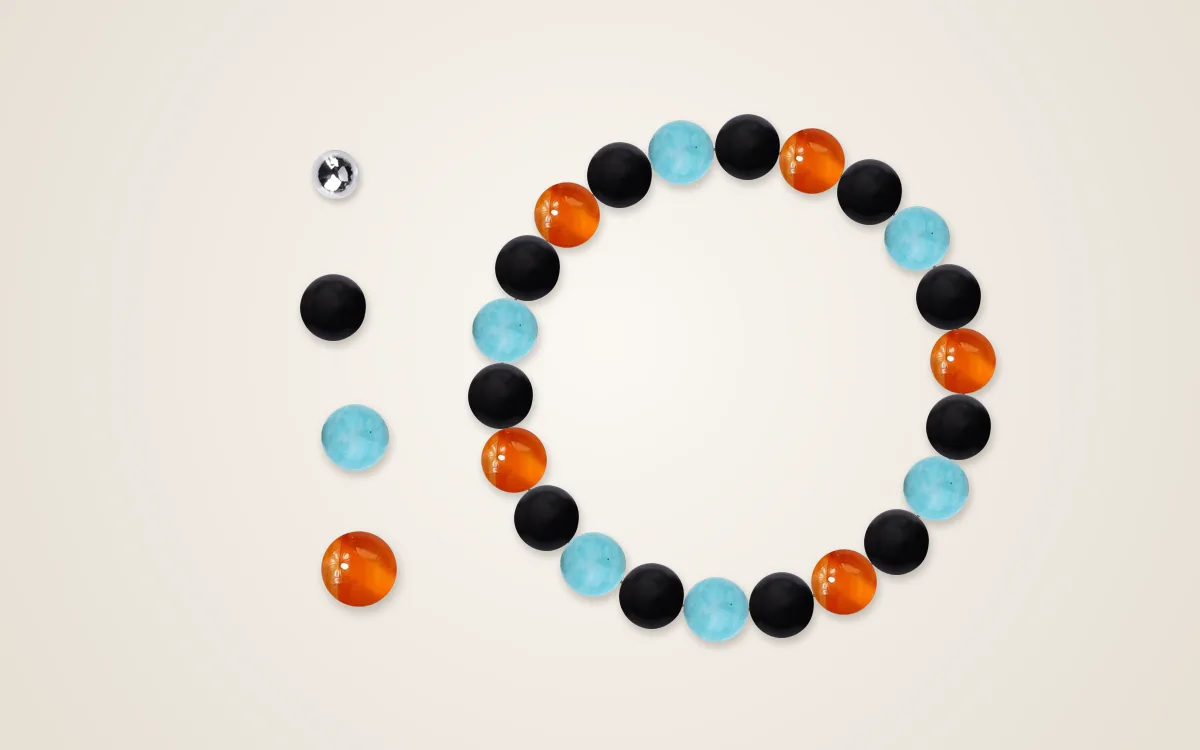
Lava stone bracelets are matte, black, light, and often sold as essential oil diffusers. This page explains what lava beads are, what to check before buying, what the oil trick does to a stretch cord, and what to wear instead if you want a dark, earthy bracelet built from the stones in the BVDIY library.
Lava beads are cut from porous volcanic rock, usually basalt, so they're light, matte and rough to the touch. Evenly jet-black lava beads are usually dyed. The pores hold a drop of essential oil, but oil can weaken elastic cord, so use it sparingly and away from the knot. Lava isn't in the bracelet studio; Shungite gives a similar dark, low-shine look without the pores.
What is a lava stone bead?
A lava stone bead is a piece of volcanic rock, most often basalt, that cooled with gas bubbles trapped inside. Those bubbles leave the surface full of small pits, which is where the light weight, the matte texture and the ability to soak up oil all come from. The minerals in basalt are fairly hard, around Mohs 6, but the pitted structure makes the edges crumbly, so lava beads can shed fine grit when new and chip if knocked against tile or metal.
Undyed lava is charcoal grey to dark brown, sometimes with reddish patches. Beads that are uniformly jet black, and all the blue, pink or pastel lava beads, are dyed. Dyeing isn't a problem in itself, but it's worth knowing before the bracelet gets wet or oiled.
Do lava stone bracelets really hold essential oil?
Lava stone bracelets do hold essential oil: the pores absorb a drop and release the scent for a few hours, which is why lava bracelets are sold as diffuser bracelets. Three cautions if you try it:
- The cord: essential oils and perfume can weaken many elastic cords. On a stretch bracelet, oil only two or three beads well away from the knot, and let the oil soak in before wearing.
- Your skin: some essential oils irritate skin when undiluted. Put the drop on the outside of the bead, follow the directions on the bottle, and stop if your wrist gets red.
- Your neighbors on the strand: soft stones such as malachite or rhodochrosite can dull if oil and its solvents keep running onto them.
If scent matters more than the look, a lava bead or two on a separate bracelet is easier to manage than a whole oiled strand.
What should you check before buying a lava bracelet?
Before buying a lava bracelet, check four things on the listing or in your hand:
- Dye. Rub a bead with a damp white tissue. Grey or black on the tissue means the dye will rub onto skin and cuffs too.
- Drill holes. Rough, jagged holes fray elastic faster. Look along the strand for any bead whose hole edge looks chipped.
- Bead size and roundness. Lava varies more than polished stone. Uneven beads leave gaps on the cord where it can show.
- What it's paired with. Lava's grit can scuff soft or polished neighbors over time. Hard stones such as quartz and agate are better partners than soft ones.
Lava is often strung with wood beads, which share its matte, natural feel; the guide to wood beads covers that material.
How do you care for a lava stone bracelet?
Keep a lava bracelet dry, brush it rather than wash it, and go easy on the oil. In practice:
- Take it off before showering, swimming and workouts. Pores trap soap and sweat, and the cord tires faster when soaked.
- Every week or two, brush the beads with a dry, soft toothbrush to clear lint and skin oil from the pits.
- If you've been using oil, wipe off any excess before bed and let the bracelet air out overnight on a flat surface.
- Store it apart from polished bracelets, which the grit can scratch.
More on keeping the elastic in good shape is in the bracelet care guide.
What dark stone can you wear instead from the bracelet studio?
The studio builds with natural gemstone beads only, and lava isn't among them, but several stones give a dark, earthy bracelet. None of them is porous, so none will hold oil; they're alternatives for the look.
| Stone | Finish compared with lava | Mohs (approx.) | Note |
|---|---|---|---|
| Shungite | Satin to matte black, the closest in mood | About 3.5 to 4 | Soft; wipe clean, avoid knocks |
| Black Onyx | Glossy black, smooth | 6.5 to 7 | Hard-wearing; commonly dyed |
| Hematite | Mirror-shiny gunmetal, heavy | 5.5 to 6.5 | Best kept dry |
| Smoky Quartz | Transparent grey-brown | 7 | Water fine; lighter in color |
One build: for a 17 cm wrist at 10 mm, the studio gives 19 bead positions. Place 16 Shungite and put 3 Carnelian together at the front, the orange-on-black pairing often seen with lava. That's 16 Shungite at $2.99 and 3 Carnelian at $1.84, plus the $12.99 stretch base, for $66.35.
For a harder-wearing and cheaper version, swap the Shungite for Black Onyx: 16 Black Onyx and 3 Carnelian come to $47.95. It's glossy instead of matte, but at Mohs 6.5 to 7 it shrugs off the knocks that would scuff Shungite. For a man who wants a plain dark bracelet, the men's bracelet guide has more combinations.
Sources: Basalt and the hardness of the stones named: Mindat mineral database. Lava stone's meaning in this guide is traditional folklore, not a health claim.