
Clear quartz is the bead most designs end up using somewhere, as a full strand, a filler between colored stones, or the base of a necklace. This page covers how it looks on skin, how much of it to use with other stones, and three builds with exact prices.
Clear quartz is colorless natural quartz, hardness 7, and at $1.60 a bead it is one of the cheapest stones in the studio. Used alone it looks like water on the wrist. Mixed with a colored stone, two or three clear beads for every colored one keep each color distinct. A full 8 mm strand for an 18 cm wrist is 24 beads and $51.39.
What does clear quartz look like on the wrist?
Clear quartz looks like a row of water drops: transparent, bright at the edges, and tinted by whatever sits behind it. On a pale wrist it looks almost white; on deeper skin it takes on a warm glow; against a black sleeve it reads grey. Most beads carry a few natural inclusions, thin white veils or tiny fractures that catch light, and a strand with some variation looks more natural than a perfectly glassy one.
Bead size changes the effect more than with colored stones. At 6 mm clear quartz looks fine and sparkly; at 10 mm each bead acts like a lens and magnifies the skin under it, which some people like and others find too glassy. For a first clear bracelet, 8 mm is the easy middle.
Is it clear quartz or glass?
Natural clear quartz feels cold when you first touch it and stays cool for a few seconds; glass warms up faster. Under a 10x loupe, glass often shows tiny round gas bubbles, while quartz shows irregular veils and fractures. Glass is also softer, about 5.5 on the Mohs scale, so cheap "crystal" beads tend to chip around the drill hole. Bead labels use the word crystal loosely, and this guide to crystal bead labels sorts out what it can mean. The bead card for every stone in the BVDIY studio states the material and any treatment, and Clear Quartz is listed as untreated.
How much clear quartz should go in a mixed bracelet?
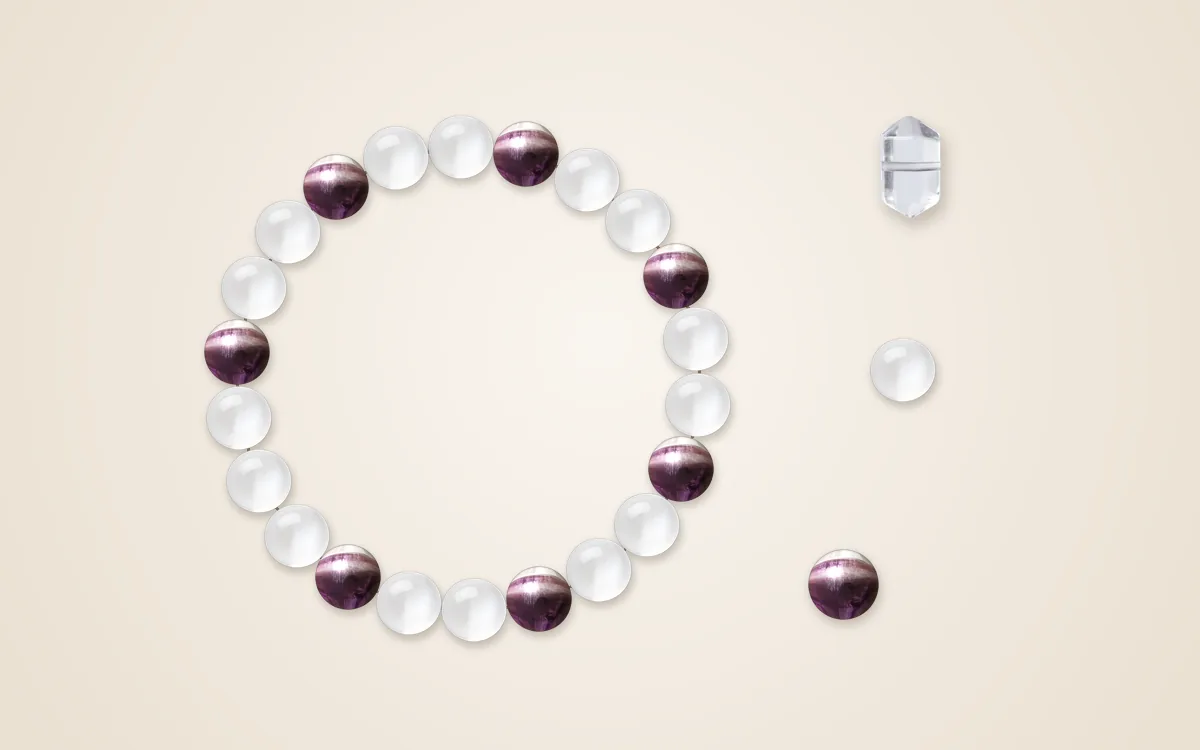
Two to three Clear Quartz beads for every colored bead is the range where each colored bead stands out on its own. Go below that and the colored stone takes over the strand; go above it and the bracelet reads as clear with a few accents. Some working ratios on an 18 cm wrist at 8 mm (24 positions):
- 1 to 1, alternating: 12 colored, 12 clear. A busy, polka-dot rhythm. Good with dark stones such as Garnet or Black Onyx.
- 1 to 2: 8 colored, 16 clear. The colored stone still dominates from a distance.
- 1 to 3: 6 colored, 18 clear. Clean and light, the best choice for pricey accent stones.
- One front block: 5 to 7 colored beads together at the top of the wrist, clear everywhere else. Looks like a full colored bracelet from above.
Clear quartz is also the cost lever. Rutilated Quartz is $6.20 a bead, almost four times the price of Clear Quartz, so a 1 to 3 mix gets you the gold needles on show for far less than a full strand. Ratios don't always divide the positions evenly. When they don't, two beads of the same stone meet where the pattern closes, and you can turn that spot to the underside of the wrist.
What does a three-quartz bracelet look like?
A three-quartz strand uses clear quartz in three forms: plain Clear Quartz, Rutilated Quartz with golden needles, and Tourmalinated Quartz with black needles. From a distance it reads as one clear bracelet; up close every few beads have something inside them. It suits someone who likes neutral jewelry but wants detail.
For an 18 cm wrist at 8 mm, the studio gives 24 positions. Use the pattern Clear, Clear, Rutilated, Clear, Clear, Tourmalinated and repeat it four times. That is 16 Clear Quartz at $1.60, 4 Rutilated Quartz at $6.20 and 4 Tourmalinated Quartz at $4.20. The beads come to $67.20, so the bracelet is $80.19 with the $12.99 stretch base.
A plain clear strand works as the base of a stack. For a 16 cm wrist at 6 mm, 29 Clear Quartz beads cost $59.39 in total, and the fine 6 mm size sits flat next to a watch or a colored bracelet. The bracelet stacking guide has more on wearing several strands together.
Does clear quartz work for a necklace?
Yes, and a necklace is where clear quartz is at its best, because a long clear strand catches more light on the collarbone than a short one on a wrist. The BVDIY studio's beaded necklace starts at $18.99 and comes in 16, 18, 20, 22 and 24 inch lengths. An 18 inch necklace at 8 mm gets 28 positions; filled with Clear Quartz it comes to $63.79.
If the necklace will be worn over darker clothing, the clear beads will look grey against the fabric. Over bare skin or a light top they look brightest. Swap 4 of the 28 beads for a colored stone at the center front if you want a focal point. More length and style choices are in the custom necklace ideas.
Why is clear quartz called crystal?
The word crystal comes from the ancient Greek krystallos, meaning ice, because rock crystal was once thought to be ice that never melted. In modern folklore, clear quartz is traditionally associated with clarity and focus, the line on its studio bead card, and it sits under the Clarity filter in the bead library. Treat the meaning as tradition; the reason clear quartz ends up in so many bracelets is practical: it goes with every other stone.
How do you keep clear quartz looking clean?
Clear quartz shows dirt more than any colored stone, since there's no color to hide a film of lotion or soap. Wipe it with a soft dry cloth after wearing. Every week or two, wash it in lukewarm water with a drop of mild soap, rinse, and dry the strand flat. At Mohs 7 it shrugs off daily wear, but a hard knock on tile or stone can chip the edge of a bead, and Aquamarine, which is harder, can leave fine scratches if the two are stacked tightly.
Sources: Quartz and glass hardness, rock crystal: Mindat mineral database and GIA Gem Encyclopedia. Stone meanings are traditional folklore, not health advice.