
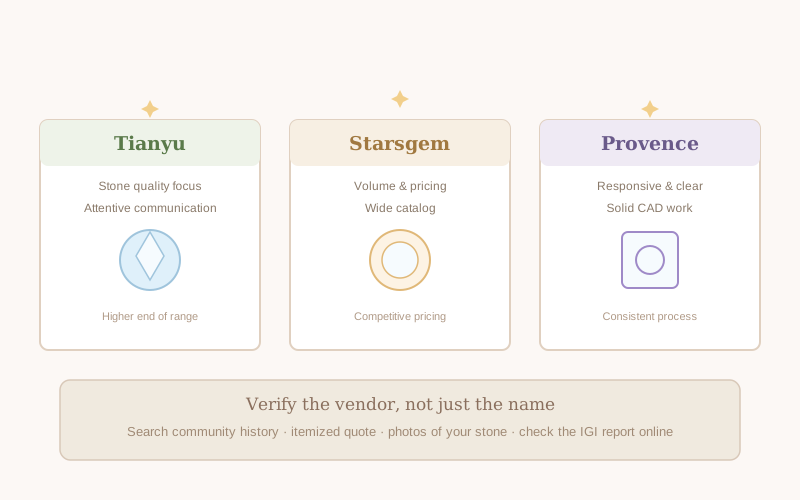
Choosing who makes your lab-grown diamond ring matters as much as choosing the stone. Reputations and rankings describe other people's past orders; the checks below protect your order, whichever jeweler you use.
Look for a jeweler that lets you verify the grading report online, shows your actual stone, has you approve the design before production, and puts price, timeline, and returns policy in writing. Pay through a method with buyer protection. A good jeweler welcomes every one of these checks; vague answers are the warning sign.
1. The 9 checks before you pay
- Certificate you can look up. Ask for the grading report number and check it on the issuing lab's own website.
- Your actual stone, on camera. A photo or short video of the specific stone, ideally next to its certificate number.
- Itemized quote. Stone, setting, metal and any extras priced separately, so you can compare like for like.
- Design approval before production. A CAD drawing or 3D preview you sign off on before metal is cast.
- Written specifications. Shape, carat, color, clarity, metal, ring size and band width confirmed in writing.
- Staged payment with protection. A deposit and a balance, paid through a method that offers buyer protection.
- Clear timeline. Production and shipping times stated up front, including what happens if they slip.
- Returns, resizing and warranty. Read the policy before ordering, not after delivery.
- Responsive, specific communication. Clear answers to precise questions are the best predictor of a smooth order.
What should I look for in a lab-grown diamond jeweler?
The nine checks are what to ask. The table below is how to read the answers.
| What to look for | Good sign | Warning sign |
|---|---|---|
| Grading report | Report number given before you pay; it looks up on the lab's website and matches the stone | Report "available after purchase", or a number that does not look up |
| The actual stone | Photo or video of your specific diamond, ideally with the report number visible | Only stock or catalog images |
| Design approval | A preview or CAD you approve before production | Production starts on a verbal description |
| Price | Itemized: stone, setting, metal, extras | One lump-sum figure that changes when you ask questions |
| Timeline | Production and shipping times in writing | "Soon" or "a few weeks" with no date |
| Policies | Returns, resizing, and warranty published before you order | Policies only explained after delivery |
| Payment | Card or another method with buyer protection | Pressure to pay by untraceable transfer |
| Communication | Specific answers to specific questions | Generic replies or pressure to decide quickly |
Is it safe to buy a lab-grown diamond online?
It can be, if the purchase leaves a paper trail you can check. The stone should come with an independent grading report you can verify, the specifications should be confirmed in writing, and you should see the finished piece, in photos or on video, before it ships. Pay with a method that offers buyer protection and keep every message, quote, and photo until the ring is in your hands. Buying online is riskier when any of these are missing, not because the stone is lab-grown.
2. How to check a lab-grown diamond certificate
The two certificates you will see most often on Chinese lab-grown diamonds are IGI and GIA laboratory-grown reports. Both are independent laboratories, and both publish their report numbers online. Enter the number on the lab's website and you should see the exact stone described in the certificate: carat, color, clarity, cut, dimensions, and an origin line stating the stone is laboratory-grown.
Two details matter. First, the certificate describes a specific stone, so the number on the paper must match the number engraved on the diamond's girdle — a magnifying loupe or a phone camera with good zoom is enough to read it. Second, the certificate does not guarantee the finished ring; it only describes the loose stone. The setting, the metal, and the workmanship are the vendor's responsibility, which is why the CAD approval stage matters as much as the certificate.
3. What reviews can and cannot tell you
Community reputation describes past orders; it does not guarantee your next one. Stone selection, CAD interpretation and quality control vary per order, so the practical question is not "which jeweler is best?" but "how do I make sure my order is the good one?" The answer is the checklist above, applied every time.
"Best" also depends on what you value. Decide your own priorities first — center stone quality, design input, price, or speed — then judge every option against them. For help with the stone itself, see our comparison of lab diamonds vs natural diamonds vs moissanite.
4. How BVDIY handles these checks
If you would rather not coordinate every step yourself, the BVDIY lab-grown diamond ring studio lets you choose the diamond shape, carat, color, clarity, cut, head, band and metal in 3D, with live pricing for each choice. Here is how our own process maps onto the checklist:
- Certificate: every center diamond ships with its grading report, and you can choose the grading lab when you order.
- Design approval: you see the full design in 3D before ordering, and availability, specifications, and certification are confirmed before production.
- Your actual ring: before shipping, we photograph the finished ring and send the photos for your approval.
- Timeline: made to order, typically shipping in 15–20 days, with the estimated ship date shown in the studio; standard delivery takes 5–10 business days within the US and Canada.
- Changes and policies: you can modify or cancel within 1 hour of ordering; after production starts the design cannot be changed. Custom rings are final sale unless damaged or defective and cannot be exchanged for a different style or size. Resizing is available for a fee; contact us for a quote.
Hold us to the same nine checks you would apply to anyone else.
When is this checklist not enough?
A checklist protects an order; it cannot make every route the right one. If you need a ring within a couple of weeks, a made-to-order piece is the wrong fit. If you want to try rings on and return the ones you do not keep, buy from a seller with a returns window on stock pieces, because custom work is usually final sale. And if resale value matters to you, lab-grown diamonds are not the right purchase: treat them as jewelry, not an investment.
Whichever route you choose, the rule that protects you is the same: get the specifics in writing, look at the actual product before you pay the balance, and keep every record until the ring is in your hands.