
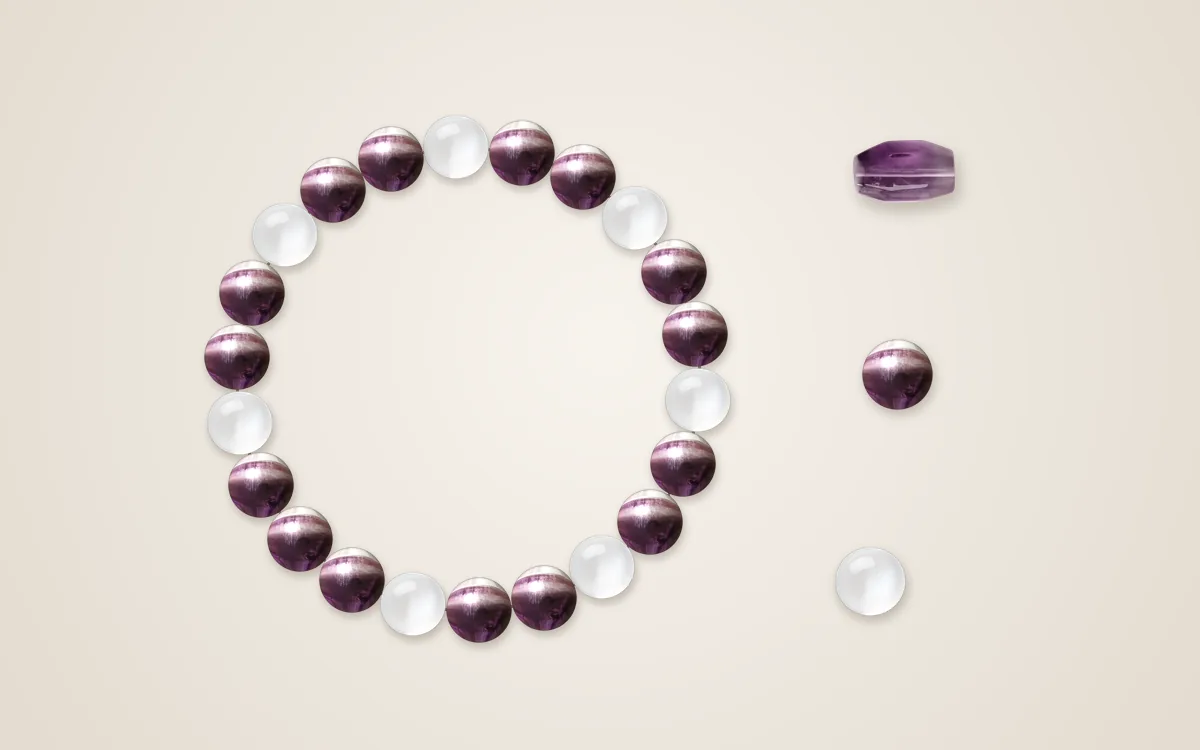
This guide is for anyone choosing amethyst for a bracelet, for a February birthday or because purple is their color. It explains why amethyst beads vary so much in shade, what the heat treatment on the bead card means, how to keep the color from fading, and which stones to pair with it.
Amethyst is purple quartz, hardness 7, so it suits daily wear. Shades run from pale lilac to deep violet, and some fading can happen with long exposure to strong sunlight or heat, so don't store it on a windowsill. Amethyst is commonly heat-treated, which is stable. A full 10 mm strand for a 20 cm wrist, 22 beads at $2.53 each, costs $68.65.
What shades do amethyst beads come in?
Amethyst beads run from a pale pinkish lilac through medium purple to a violet so deep it looks almost black indoors. The color comes from traces of iron in quartz, changed by natural radiation in the ground, and it is rarely even through a whole crystal. Beads cut from one rough show stripes and patches of stronger and weaker color, which is why a natural strand never matches bead for bead.
In faceted gems, the deepest, most even purple sells for the most. In beads the trade-off is different: very dark amethyst looks lively in daylight but can turn into a black band under warm indoor lighting. A medium purple shows its color in more situations. Every Amethyst bead in the studio costs $2.20 at 6 and 8 mm and $2.53 at 10 mm, so the choice is mostly about look.
What does "commonly heat-treated" on the bead card mean?
It means the amethyst was probably heated to adjust its color, which is standard practice in the gem trade. Gentle heating lightens amethyst that is too dark or clears a brownish tint. The change is permanent under normal wear, and heated amethyst is still natural quartz with the same hardness.
Heat amethyst further and the purple turns yellow to orange, which is how most citrine on the market is made. The citrine guide explains how to tell natural from heated citrine. The BVDIY bead card states the treatment for every stone, and Amethyst is one of only two in the library listed as commonly heat-treated; Carnelian is the other.
Does amethyst fade in sunlight?
Some amethyst can lose color with long exposure to strong light or heat, so the safe habit is to keep it out of direct sun when you aren't wearing it. Wearing the bracelet outdoors on normal days won't bleach it. What does damage it is weeks on a sunny windowsill, a car dashboard in summer, or a display shelf under a strong lamp.
- Store it in a drawer, a pouch or a closed box.
- Don't leave it in a hot car or next to a heater.
- Wipe it with a soft cloth after wearing; lotion and sunscreen leave a film that flattens the purple.
- Wash it occasionally in lukewarm water with mild soap, then dry it flat in the shade.
Which stones go well with amethyst?
Clear Quartz is the classic partner, because the clear beads make the purple look brighter and cost only $1.60 each. Beyond that, the pairing depends on the look you want:
- Rose Quartz: pink next to lilac. Soft and feminine, and the two are close enough in lightness that neither shouts.
- Smoky Quartz: brown-grey that mutes the purple. A good choice for a man's bracelet or for someone who wears mostly neutrals.
- Labradorite: grey with a blue flash. Deep violet and labradorite together look like a dusk sky.
- Yellow Jasper: purple and yellow sit opposite each other on the color wheel, so a few yellow beads make the amethyst look more purple.
- Fluorite: often banded purple and green. It suits amethyst well, but at Mohs 4 it scuffs, so keep it to a few beads.
Amethyst is the only stone in the library's purple color group, so a monochrome purple bracelet means all amethyst. For the pink side of this palette, see the rose quartz bracelet guide.
What does an amethyst bracelet cost on a small or large wrist?
A full amethyst strand for a 20 cm wrist at 10 mm costs $68.65, and a mixed lilac fade for a 14 cm wrist at 6 mm costs $60.59. The two layouts:
Deep violet for a large wrist. For a 20 cm wrist at 10 mm, the studio gives 22 positions. Fill every one with Amethyst: 22 beads at $2.53 is $55.66, and with the $12.99 stretch base the total is $68.65. At 10 mm the stones read as strong purple in daylight and dark violet indoors, which suits someone who wants color without it being loud. The men's bracelet guide has more ideas for bigger wrists.
Lilac fade for a small wrist. For a 14 cm wrist at 6 mm, the studio gives 26 positions. Lay them out as 4 Clear Quartz, 4 Rose Quartz, 10 Amethyst, 4 Rose Quartz, 4 Clear Quartz, so the purple sits on top of the wrist and fades through pink to clear at the back. That is 10 Amethyst, 8 Rose Quartz and 8 Clear Quartz for $60.59. Six millimeter beads keep the strand fine on a small wrist, and 10 mm would look heavy there.
Why was amethyst said to guard against drunkenness?
The belief comes from the name: ancient Greek amethystos means "not intoxicated", and the stone was once thought to keep its wearer sober. Nobody should rely on it for that, but it's a good story to tell with a gift. Today's folklore is gentler. Amethyst is traditionally associated with calm and clarity, the line on its studio bead card, and it sits under the Clarity filter.
Amethyst is also the birthstone for February. If you're planning bracelets for several family birthdays, the birthstone ideas for each month cover the other months.
Sources: Amethyst color, heat treatment, fading, name origin and February birthstone: GIA Gem Encyclopedia and GIA birthstones by month. Hardness: Mindat mineral database. Stone meanings are traditional folklore, not health advice.