
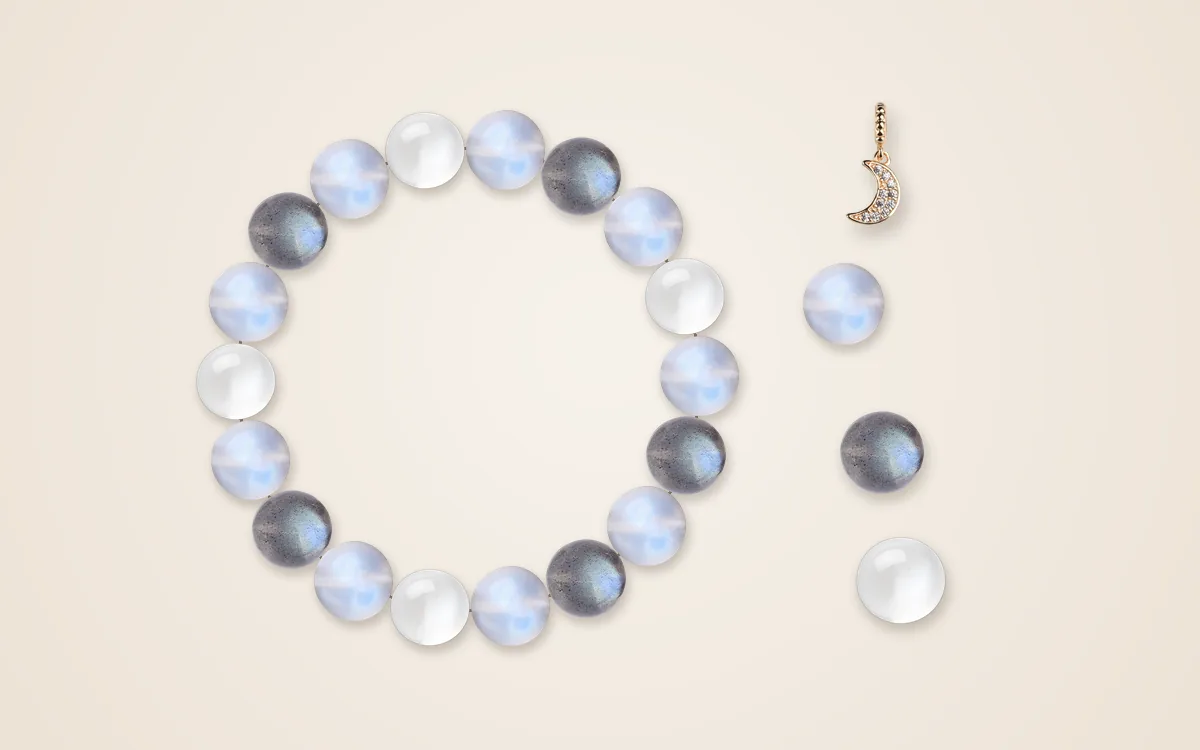
Moonstone is bought for one thing: the soft light that seems to float inside the bead. This guide explains where that glow comes from, which "moonstones" are really other stones or glass, how to keep a moonstone bracelet from cracking, and how to get a pale, glowing look from stones the BVDIY studio does carry.
Moonstone is a feldspar, about 6 to 6.5 on the Mohs scale, with a blue-white glow called adularescence that moves as the bead turns. It's fine for careful daily wear but can split if knocked hard. Opalite, a common substitute, is glass. The BVDIY studio doesn't stock moonstone; Labradorite with Clear Quartz gives a similar flash on white.
What is moonstone, and why does it glow?
Moonstone is a feldspar, usually orthoclase, made of extremely thin, alternating layers of two different feldspars. When light enters the stone it scatters off those layers and comes back as a soft, milky sheen that seems to sit just below the surface. Gemologists call that effect adularescence, after adularia, an old name for the mineral.
The glow is directional. It shows most strongly when you look down a particular axis of the crystal, which is why cabochons are cut with that axis pointing up. Round beads are drilled without regard to it, so on a moonstone strand each bead flashes at a different angle, and some barely flash. That's normal, not a sign of a fake.
Moonstone comes in several body colors:
- White or colorless with a blue sheen: the classic, most valued type, mostly from Sri Lanka and India.
- Peach and grey: warmer or darker bodies with a white or silver sheen, cheaper and common in beads.
- Black: a loose trade name for dark feldspar with a sheen, sometimes labradorite.
Is rainbow moonstone really moonstone?
Strictly, no. "Rainbow moonstone" is a white variety of labradorite, a different feldspar, and its blue, purple and gold flashes come from labradorescence rather than adularescence. The trade adopted the moonstone name because the white body looks similar. It's a real natural stone, often prettier in bead form than true moonstone, and many rainbow moonstone beads show a small black line or speck of tourmaline inside, which helps identify them.
Rainbow moonstone and dark labradorite are the same mineral family, one pale and one grey. That's useful when looking for a substitute, since the studio's Labradorite shows the same kind of flash on a darker body.
How do you tell real moonstone from opalite and glass?
Real moonstone's glow moves and fades as you tilt it; most imitations glow evenly from every angle. The common substitutes:
| Bead | What it is | Giveaway |
|---|---|---|
| Moonstone | Natural feldspar | Glow floats and slides with the angle; small internal cracks or lines are normal |
| Rainbow moonstone | White labradorite | Colored flashes, often with black specks or lines inside |
| Opalite | Man-made glass | Blue against dark, amber against light; perfectly clean, sometimes with round bubbles |
| Milky or "moonstone" glass | Glass | Even, flat milkiness from every angle; no internal structure |
| Frosted quartz | Quartz with a matte surface | White but no sheen; frosting rubs shiny at the drill hole |
A strand of moonstone beads where every bead is flawless and glows the same is a warning sign. Natural moonstone almost always shows a few hairline cracks, feathers or cloudy patches, and its glow is patchy across a strand.
Is moonstone tough enough for a bracelet?
Moonstone is tough enough for a bracelet worn with some care. At 6 to 6.5 on the Mohs scale, it is a little softer than quartz (7), so quartz beads rubbing against it will scuff the polish over time. The larger risk is cleavage: feldspar has flat planes of weakness, and a hard knock on a counter can split a bead cleanly along one.
- Wear it on the wrist that doesn't do the heavy work, and take it off for the gym and gardening.
- Don't stack it tightly with quartz or onyx bracelets.
- Clean it with lukewarm water and mild soap. Skip ultrasonic and steam cleaners, and don't leave it on a hot car dashboard.
- Store it in its own pouch.
Smaller beads are safer. A 6 mm moonstone strand takes knocks better than 10 mm beads, which have more mass behind each impact.
Why is moonstone a June birthstone, and what does it mean?
Moonstone is one of three June birthstones, with pearl and alexandrite, on the modern list. Of the three, moonstone and pearl are the ones you'll find as round beads; natural alexandrite is rare and almost always faceted.
The folklore is mostly about the moon. The Romans are said to have believed moonstone formed from moonlight, and in modern crystal folklore it's traditionally associated with intuition, calm and new beginnings. It's often suggested as a gift for a new mother. For other months, the birthstone bracelet ideas go through the full list.
How can you get a moonstone look from stones in the BVDIY studio?
These three builds are alternatives with a similar pale or flashing look; none of them is moonstone. Each gets at a different side of it.
Flash on white (closest to rainbow moonstone): for an 18 cm wrist at 6 mm the studio gives 32 positions. Alternate Clear Quartz and Labradorite all the way round, 16 of each, at $1.60 and $3.40 a bead: $92.99 with the $12.99 base. The clear beads provide the white and the labradorite provides the flash as the wrist turns.
Blue haze for everyday wear: for a 15 cm wrist at 8 mm the studio gives 21 positions. Place two Clear Quartz, then one Blue Lace Agate, seven times: 14 Clear Quartz and 7 Blue Lace Agate, $52.19 in total. Blue lace agate's pale blue bands echo the blue sheen of white moonstone, and both stones are quartz-hard, so this one can handle handwashing.
Silky white for evenings: Selenite has the closest silky, moon-white sheen, and its name comes from Selene, the Greek moon goddess. It's soft (about Mohs 2) and breaks down in water, so keep it dry. For a 14 cm wrist at 10 mm the studio gives 16 positions: put a Clear Quartz bead after every three Selenite, for 12 Selenite and 4 Clear Quartz at $53.47.
Clear quartz on its own reads as water rather than moonlight; the clear quartz guide shows what it looks like as the main stone. If you were weighing moonstone against pearl, the pearl and crystal comparison covers the softer pearly look. Measure the wrist first: the studio takes whole centimeters from 14 to 20, and between sizes you choose the larger.
Sources: Moonstone structure, adularescence, rainbow moonstone and the June birthstone: GIA Gem Encyclopedia and GIA birthstones by month. Feldspar hardness and cleavage: Mindat mineral database. Stone meanings are traditional folklore, not health advice.