
Choosing a lab-grown diamond for an engagement ring is mostly about knowing where your money becomes visible sparkle and where it only becomes a better line on a report. This guide walks through the order of decisions that works in practice, explains what "eye-clean" means, and shows how to check the stone before you commit.
Prioritize cut first, because it drives sparkle. Then pick a carat size you are happy with. For color, G–H usually looks white in white metal; for clarity, look for an eye-clean stone, often VS2 or SI1. Always confirm the grading report and ask to see the actual diamond.
What should I prioritize: cut, color, clarity, or carat?
The order that tends to give the best-looking ring for the budget is cut, then carat, then color, then clarity. Cut decides how light moves through the stone; a well-cut diamond with modest color and clarity grades usually looks brighter than a poorly cut stone with top grades. Carat comes next because size is what most people notice first. Color and clarity are where it is easy to overspend on differences you cannot see once the stone is in a ring.
| Factor | What it affects | Sensible target for most rings | Where overspending happens |
|---|---|---|---|
| Cut | Brilliance, fire, how lively the stone looks | The top cut grade available (Ideal or Excellent) | Rarely — cut is the last place to save |
| Carat | Visible size | The size you want, within budget | Jumping to a round number (1.00 ct) when 0.90 looks the same |
| Color | How white the stone looks | G–H in white gold or platinum; a little lower can work in yellow or rose gold | D–F, which is hard to tell apart once set |
| Clarity | Visible inclusions | Eye-clean (often VS2 or SI1) | VVS and above, which needs magnification to tell apart |
What does eye-clean mean, and is VS2 or SI1 enough?
An eye-clean diamond has no inclusions you can see with the naked eye at normal viewing distance. It is a practical description, not a grade: you will not find "eye-clean" on a grading report. Clarity grades are assigned under 10x magnification, so a VS2 or SI1 stone can have inclusions that are obvious under a loupe but invisible when the ring is on a hand.
Whether a given stone is eye-clean depends on three things: the size and position of the inclusions, the diamond's size (larger stones show more), and its shape. Brilliant cuts such as round, oval, and cushion hide inclusions well. Step cuts such as emerald and Asscher have long open facets that act like a window, so it is wise to go up a clarity grade with those. When you cannot see the stone in person, VS2 is the safer floor; SI1 is worth considering only if you can see photos or video of that exact diamond.
Which color grade looks white in a ring?
Color grades run from D (colorless) downward. In white gold or platinum, many buyers find G or H looks white face-up, especially in a round brilliant, whose sparkle masks a faint tint. Yellow and rose gold warm the stone anyway, so a slightly lower grade can look the same. Elongated shapes and larger stones show color more than a small round does.
How big should the diamond be?
Choose the size by how it looks on the hand rather than by the number. Two practical tips: a well-cut stone just under a round number (0.90 instead of 1.00, 1.40 instead of 1.50) looks the same size and often costs less, and elongated shapes such as oval, pear, and marquise look larger face-up than a round of the same carat weight. Our lab-grown diamond carat size chart shows the approximate millimeter size of each shape from 0.50 to 4.00 carats. A halo setting also makes the center look bigger — see solitaire vs halo.
How do I check the grading report?
A lab-grown diamond for an engagement ring should come with a report from an independent lab. Check that the report number matches the laser inscription on the girdle, then verify the number on the lab's website. Make sure the report states clearly that the stone is laboratory-grown. Labs describe lab-grown diamonds differently: IGI reports give letter grades for color and clarity, while GIA's current service, introduced in October 2025, classifies stones as Premium or Standard. Our IGI vs GIA guide explains how to read each.
When is this approach not right for you?
This cut-first, eye-clean approach is about getting the best visible result for the money. It is not the right frame if you specifically want the highest grades for their own sake, or if you are choosing a natural diamond as a long-term store of value — lab-grown diamonds have very limited resale, and no one should promise you otherwise. It also does not help if you cannot see the actual stone and are not willing to accept a safety margin; in that case, buy one clarity grade higher than you think you need. And if the ring has to survive heavy manual work every day, the setting matters as much as the stone, so read about settings before you decide.
Putting it together
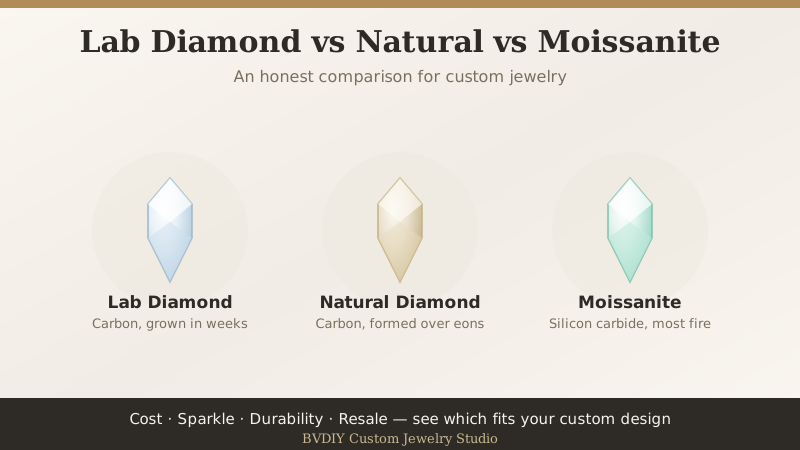
Start with shape and cut, choose the carat size you want, then set color and clarity at the lowest grades that still look white and clean. In the BVDIY ring studio you can set shape, carat, color, clarity, and cut, choose a head and band, and preview the result in 3D before you order. Each ring is made to order; see how long a custom engagement ring takes before you set a date. Still deciding on the stone itself? Compare lab diamond vs natural vs moissanite, or read whether a lab-grown engagement ring is worth it.